
How to Run an Annual Review With Your Wall Planner
An annual review done with a filled wall planner produces evidence, not impressions. Here is a simple method for doing a year-end review and setting up 2027 with better defaults.
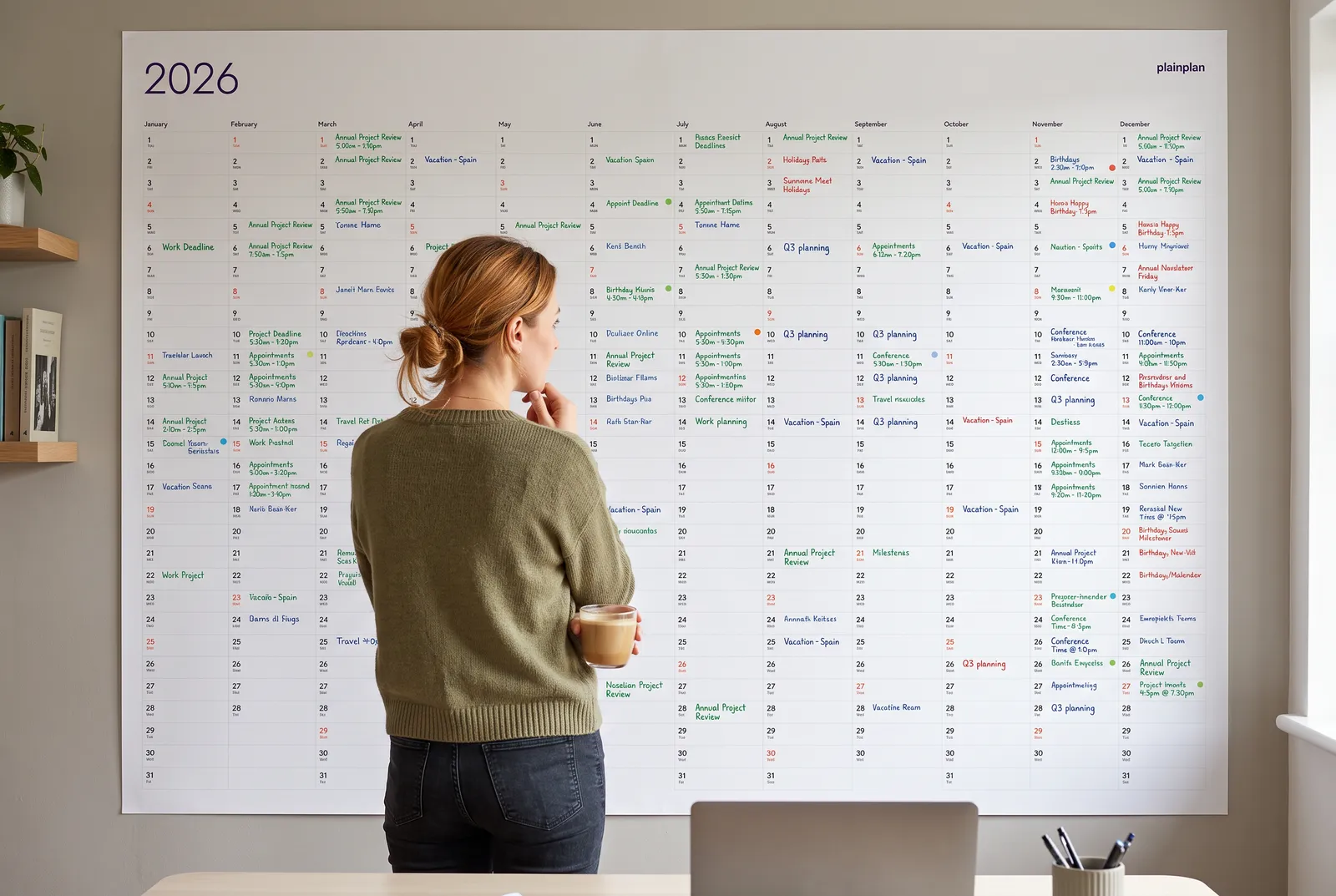
Timing the Review Right
An annual review done purely in your head produces vague impressions. An annual review done with a filled wall planner in front of you produces evidence. The difference matters, because evidence is harder to revise away with optimism.
The window between December 10 and December 20 is ideal. After the 20th, most people are managing logistics - travel, family, food - and the review gets postponed to January, when you’re already inside the new year and the old one feels less relevant.
Block two to three hours. Not an evening where you also have other things. This is the one planning session per year where depth matters more than speed. Bring the planner, a notebook, and no phone. If you use color coding on your planner, that visual layer becomes useful here: you can see at a glance which life areas dominated which periods without having to read every entry.
What Worked, What Didn’t, What Do I Want Differently
Three questions structure the whole review. What worked: which periods were productive, which projects delivered, where did you show up consistently. What didn’t: which months were chaotic, which goals never got traction, what kept getting pushed back. What do I want differently: not aspirations, but specific changes in how time is structured.
James Clear publishes an annual review each year built around a single question: are my choices helping me live the life I want to live? Chris Guillebeau’s version focuses on affirmation alongside constructive criticism - what went right, what can improve. Both approaches agree on one thing: the review is most honest when it is grounded in a record of what actually happened, not just what you remember.
The planner answers these questions more honestly than memory does. Memory is selective - it tends to recall the recent past and the emotionally significant events. The planner has everything. The week you scheduled six meetings and produced nothing is visible. So is the quiet October stretch when the best work happened.
Write the three answers in a notebook, not on the planner itself. The planner is evidence; the notebook is interpretation. Keep both.
What the Planner Shows That Memory Won’t
Look at density first. Which months were overloaded - every week full, entries bleeding outside boxes, barely a blank day? Which had open space that never got used? Overloaded months are not automatically productive ones. Often the opposite: months with too much scheduled are months where focus was thin.
Look at quarters as units. Most people have recurring patterns they don’t consciously track: a Q1 that always starts slow, a summer lull, a Q4 crunch. These patterns show clearly on a year-view planner in a way they never do month by month. If Q3 is consistently your best quarter, that’s worth knowing when you allocate big projects next year. The year-at-a-glance setup guide explains exactly how to read these patterns visually.
Look for the gaps. Time you planned to use that you didn’t. Projects that appear for two weeks and then disappear. Recurring events that stopped recurring. The gaps are often more informative than the filled weeks - they point to where expectations and reality diverged.
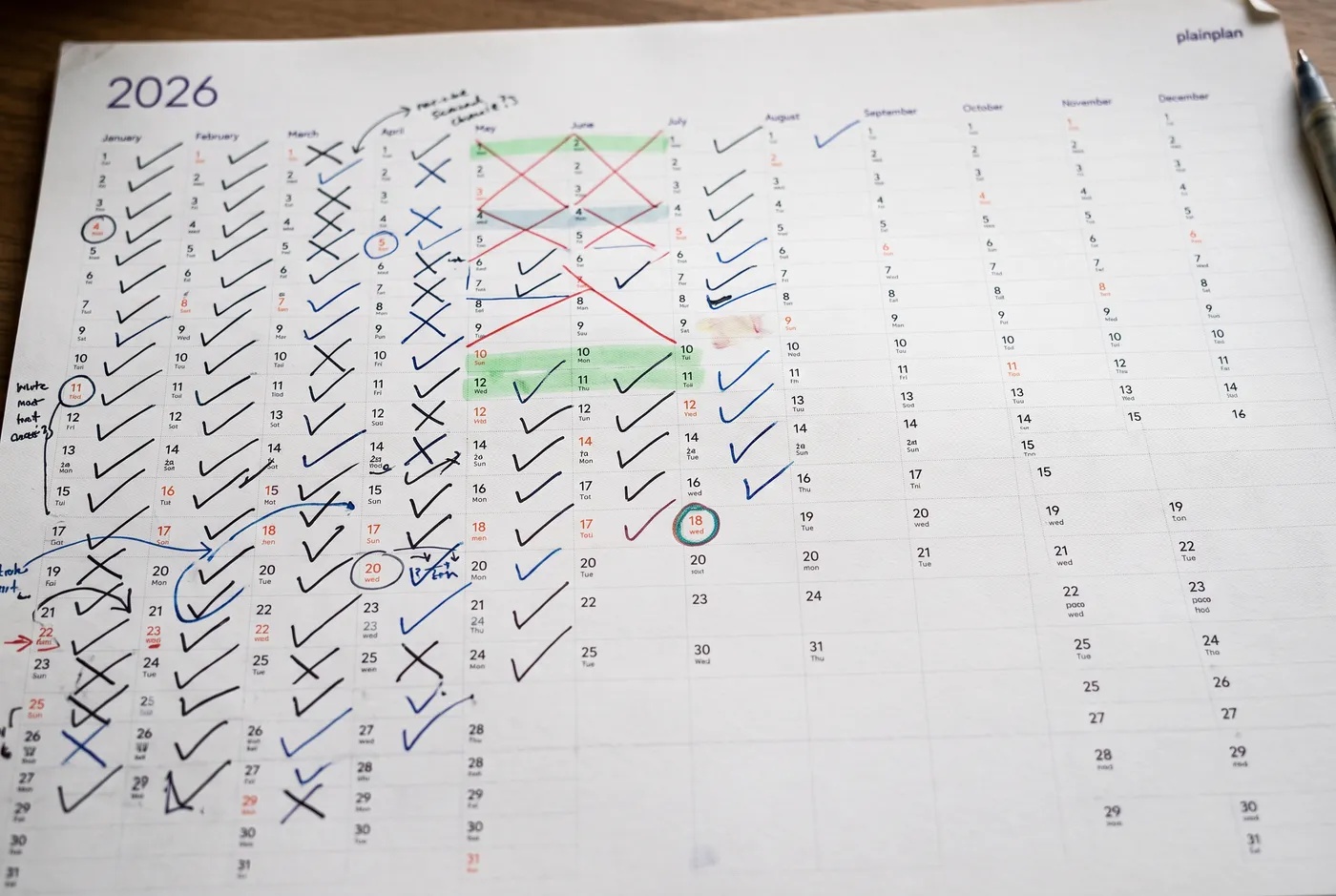
Start With Constraints, Not Aspirations
Most annual planning starts with goals: what you want to achieve, what you want to change. That’s the wrong order. Start instead with constraints - the fixed points already in the year that you cannot move.
On the new planner, block in the known constraints first: confirmed travel, school terms, major deadlines already scheduled at work, recurring commitments that will happen regardless of your plans. In most people’s lives, constraints account for more weeks than they realize. What’s left after constraints is the usable space.
Now add goals. But add them as allocations, not wishes. If a big project needs three months of execution, find three months on the planner that have the space for it. If they don’t exist, either the project gets smaller or something else gets removed. This is the exercise that turns goals into plans - and it is something only a year-view planner makes immediately visible. For strategies on translating goals into planner blocks, see Long-Term Goal Setting With a Wall Planner.
Try 2026 for free
before you buy 2027
One file. Any wall. Always sharp.
Hanging Old and New Together
Once the new planner is partially filled with constraints and allocations, hang it next to the old one. This side-by-side view is the most useful single moment in the whole process.
You can immediately see whether the new year looks like a repetition of the old one: the same dense periods, the same gaps, the same patterns. If it does, and the review identified those patterns as problems, something in the plan needs to change before the year begins rather than after.
Most people do this review mentally, which means the comparison never really happens - they can’t hold twelve months of the old year in memory while filling in the new one. The physical planners make the comparison real. It takes ten seconds to look at both and see whether next year is a revised plan or just a re-run.
The Review Only Works on a Planner You Actually Used
This method assumes you used the planner throughout the year - not perfectly, but consistently enough that it reflects what actually happened. A blank planner in December produces nothing useful for review.
If this year’s planner is sparse, the review still has value: the absence of entries is itself information. A planner you meant to use but didn’t tells you something about the friction points between intention and behavior. That’s worth investigating before repeating the same setup next year.
The fix is usually structural, not motivational. Putting the planner where you actually see it every day - kitchen, desk, beside the door - matters more than resolution. A planner in a drawer gets ignored. One on the wall at eye level gets used. The complete setup guide covers placement, sizing, and the weekly review habit that keeps a planner accurate throughout the year.
Frequently asked questions
The window between December 10 and December 20 is ideal. After the 20th most people are managing holiday logistics, and the review gets postponed to January - when you are already inside the new year and the old one feels less relevant. Block two to three hours and treat it as the one planning session per year where depth matters more than speed.
What worked: which periods were productive and where did you show up consistently. What didn’t: which months were chaotic and which goals never got traction. What do I want differently: not aspirations, but specific structural changes in how time is allocated. A completed wall planner answers all three questions with evidence rather than memory.
A filled wall planner is a record of the year as it actually happened - not as you remember it. Memory tends to recall the recent past and the emotionally significant events; the planner has everything. The week with six meetings and no output is visible. So is the quiet October stretch when the best work happened. Patterns across quarters are immediately readable in a way they never are from a month-by-month view.
Always block constraints first. Fixed points - confirmed travel, school terms, recurring work commitments - account for more of the year than most people expect. What remains after constraints is the genuinely usable space. Goals added before that exercise often collide with immovable dates, which is why plans built from aspirations alone tend to slip.
A sparse planner is still useful for review: the absence of entries tells you something about where the friction was between intention and behavior. Before setting up next year, investigate the structural cause - was the planner in an inconvenient location, too small to write in comfortably, or simply never part of a weekly habit? The fix is almost always structural, not motivational.

Sources