
Why 5-Year Planners Don’t Work (And What to Use Instead)
Most 5-year planners are abandoned by March. The problem is not discipline - it’s the planning horizon.
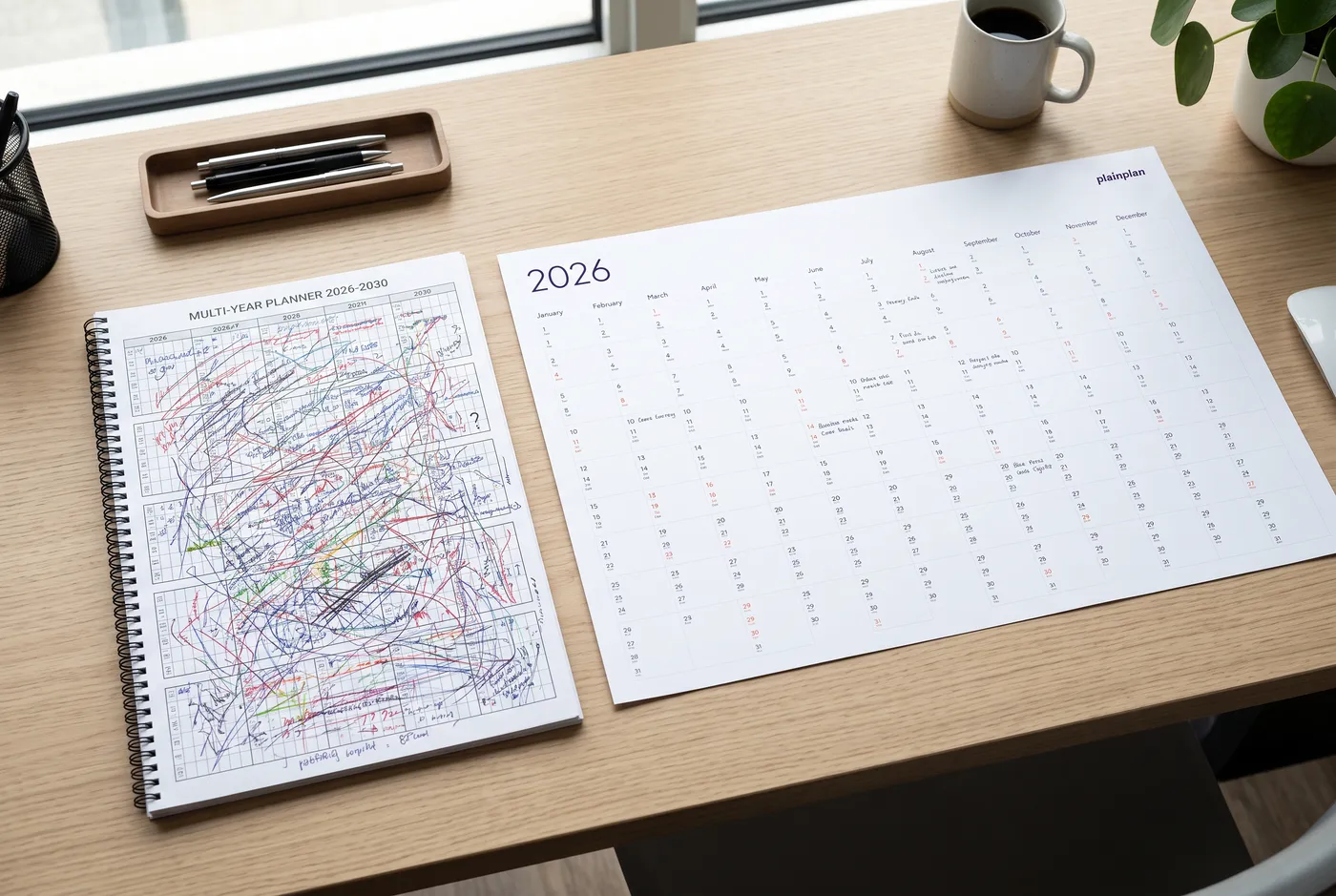
The physical reality of a 5-year planner
You know the one. It’s either gathering dust on a shelf, propped up on a desk as decoration, or sitting in a drawer half-filled from January two years ago. The 5-year planner is one of the best-selling items in the productivity market and one of the most reliably abandoned.
Open any 5-year planner that has been “in use” for more than six months. The pattern is consistent: Q1 of Year 1 is dense with notes. Q2 has some entries. The second half of Year 1 gets sparse. Years 2, 3, and 4 are almost entirely blank. Year 5 sometimes has a few aspirational items written in - retirement targets, a dream house, a marathon - but nothing actionable.
That middle section - roughly three years of blank pages - is not evidence that the person stopped caring. It is evidence that human beings cannot usefully plan at that resolution for that long. Writing “grow revenue 40%” in the Year 3 column does nothing for Tuesday. The gap between the horizon and the day is too large to bridge with a daily-format notebook.
The design promise of a 5-year planner is that it makes you think long-term. The actual effect is that it makes you feel guilty about pages you haven’t filled. That is a product design failure, not a personal one.
Why 5 years is the wrong horizon for a daily tool
A planning tool has to do two things at once: hold your long-range intentions and give you something to act on today. The 5-year planner collapses under the second requirement. Five years from now is abstract. It is not wrong to think about that horizon - it is wrong to expect a daily-use notebook to bridge it.
The problem is specificity decay. You can write a useful plan for next week. You can write a reasonable plan for next quarter. By next year, your plan is really a set of targets. By Year 3, it is a list of hopes. A tool designed around daily entries cannot hold all of those honestly at the same time.
There is also the calendar mismatch. A 5-year planner gives you roughly 1,825 days. Almost nobody has a useful, independent plan for each of those days. What they have is a rhythm - annual cycles, quarterly reviews, weekly routines - and a 5-year planner does not map well onto any of those cycles. If you want to understand the year-level rhythm better, the year-at-a-glance approach is a more honest frame for how most people actually think.
What planning research says
The research on planning effectiveness is not complicated once you strip away the self-help packaging. People plan most accurately and follow through most consistently when the planning horizon matches the feedback loop. A weekly plan works because you know by Friday whether you did the thing. A 5-year plan has a feedback loop so long that almost nothing adjusts it until too late.
The useful planning horizon for most people - the one where concrete action is still possible and feedback still matters - is somewhere between 3 and 12 months. That is long enough to see structure, short enough to hold yourself to it. This is a pattern that researchers in planning psychology describe as implementation proximity: plans close enough to execution to generate real decisions.
Annual planning sits right in the middle of that window. It is long enough to contain real projects, travel, career moves, and seasonal patterns. It is short enough that you review it and update it before the whole thing becomes fiction. This is not a productivity hack. It is just matching the tool to the cognitive task.
The sweet spot: 12 months, visible, always there
An annual planner on a wall solves the visibility problem that a 5-year notebook cannot. When it is on the wall, you do not have to decide to consult it - you see it. You absorb the patterns without effort. You notice that Q3 is already full before you agree to another project in June.
The yearly view also gives you the right level of resolution. Each day gets a mark, not a paragraph. You record what matters - deadlines, travel, events, deep work weeks - without being tempted to fill blank space with planning theater. The constraint is useful.
Twelve months is also the natural unit for most people’s real commitments: annual budgets, school years, subscription cycles, performance reviews. A year is the frame your life already runs on. The annual planner does not impose a new system - it makes the existing one visible. For a practical walkthrough, how to use a wall planner covers the setup in under 30 minutes.
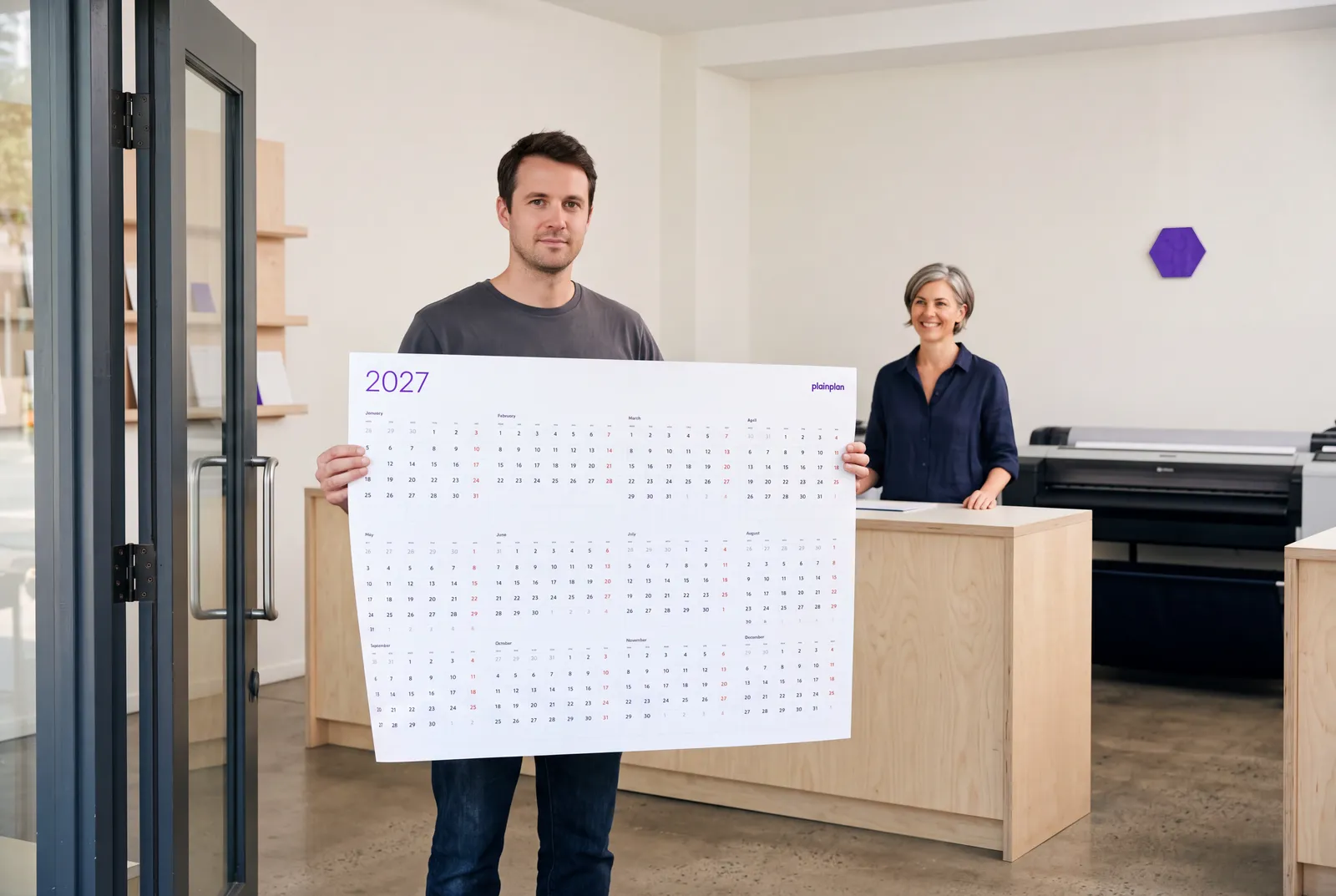
Try 2026 for free
before you buy 2027
One file. Any wall. Always sharp.
How annual wall planners replace the 5-year notebook
A 4-year planner or 5-year planner tries to serve multiple roles at once: daily scheduler, goal journal, life roadmap. An annual wall planner does one thing: it shows you your year. That focus is the source of its usefulness.
The workflow that actually works is simpler than most productivity systems admit. At the start of the year, do a 30-minute annual setup: mark fixed points, color-code areas of life, note the weeks that will be intensive. Then at the end of each quarter, spend 20 minutes reviewing what happened and adjusting the next quarter. That’s it. A structured annual review at year-end reinforces the same loop.
plainplan is built for exactly this. It is a single-page vector PDF - all 12 months, clean grid, no decorative clutter. You print it at whatever size works for your wall and mark it up however you want. The simplicity is intentional: a planner that tries to do everything usually ends up doing nothing.
The one case where long-horizon planning makes sense
There is a legitimate use for 5-year thinking. It is just not daily planning. If you are mapping a career shift, planning when to buy a house, or thinking about when you want to be debt-free, a longer horizon is the right one. Those decisions need it.
But that kind of thinking belongs in a separate document - a vision note, a life goals sheet, a strategy document you revisit once or twice a year. It does not belong in your daily planner. Mixing them is what makes both fail.
Keep your 5-year thinking in a note or a simple document. Keep your year on the wall. The two can coexist; they just should not be the same object. The annual wall planner is your operating layer. The long-horizon document is your reference layer. Use them for what they are good at, and abandon neither.
Frequently asked questions
The most common reason is specificity decay - plans become increasingly abstract the further out they project, and the daily-format notebook structure creates guilt about unfilled pages rather than useful prompts. The feedback loop is too long to sustain consistent use.
Yes, but that thinking belongs in a separate document - a vision note or strategy reference - not in a daily planner. Mixing long-horizon intentions with daily scheduling is what causes both to fail.
Research on planning effectiveness suggests 3-12 months is the window where plans stay concrete enough to act on and short enough to course-correct before they become fiction. Annual planning sits right in the middle of that range.
A wall planner is always visible - you absorb your year passively, without opening anything. A notebook requires a decision to consult it. For annual-level planning, the passive visibility of a wall planner means it actually gets used rather than forgotten on a shelf.

Sources