
Best Paper for a Printable Wall Calendar (GSM, Finish, Matte vs. Glossy)
When you download a print-ready PDF planner, the file is done. The only variable left is the paper. Get it right and you end up with something that hangs flat, survives the year, and takes pen marks.
GSM explained — and what weight to ask for
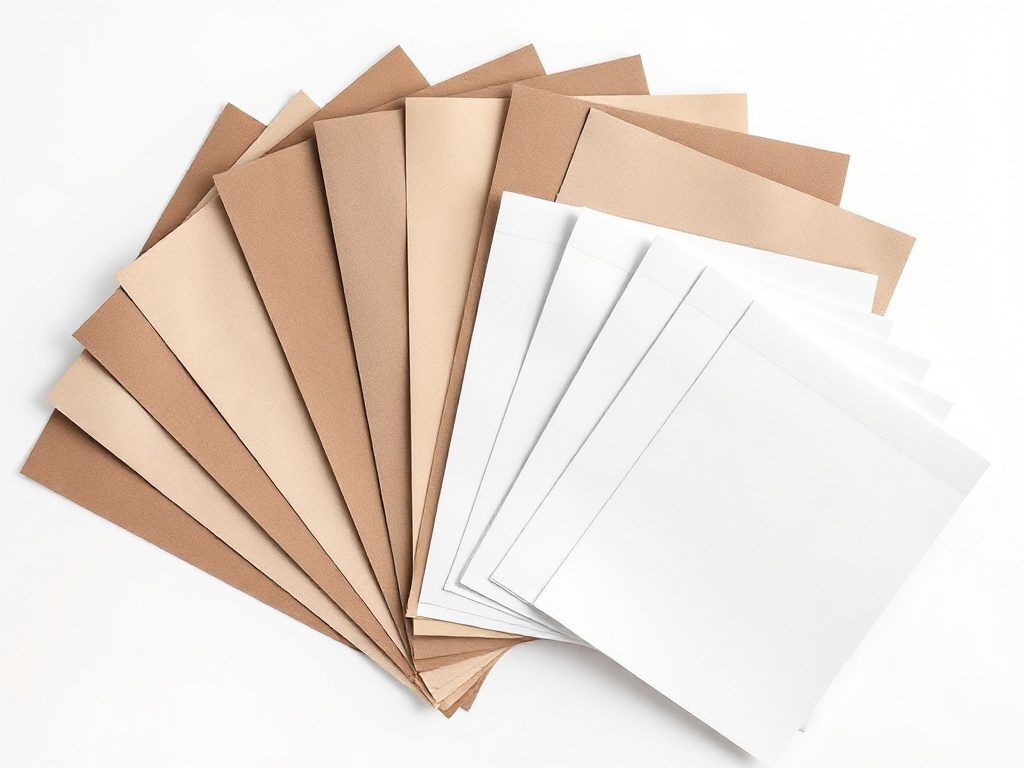
GSM stands for grams per square metre. It’s the universal measure of paper weight defined under ISO 536. Standard copy paper is 80 gsm — roughly 20 lb bond in US terms — and 80 gsm is the worldwide office standard for everyday copying and printing. For an A4 home printout, that’s fine. For anything you want to hang on a wall and look at all year, it’s not enough — it sags, and the ink from a roller-ball or marker bleeds through.
The sweet spot for a wall planner is 120–160 gsm (about 32–43 lb bond). At that weight, the sheet is stiff enough to hang flat without a frame, it takes both printer ink and handwritten notes, and it won’t curl at the corners from humidity. Most print-on-demand poster services default somewhere in this range. If you’re not sure what size to order, see our guide to printing at any size first.
Above 200 gsm, you’re into card stock territory. Unless you’re planning to laminate and frame, the extra stiffness adds cost without meaningful benefit for a flat wall planner. Save the heavy card for desk calendars that need to stand upright.
Matte vs. glossy vs. satin
Glossy paper gives you the sharpest photo reproduction and the most vivid colours. The problem is glare — a large glossy calendar reflects overhead lights and windows straight back at you. More practically, you can’t write on glossy with a ballpoint or a marker. Ink smears and takes longer to dry. For a planner you intend to annotate, glossy is the wrong choice.
Matte finish absorbs ink instead of reflecting it. Colours look slightly softer, but glare is gone and you can write on the surface with virtually any pen — ballpoint, gel, fine-liner, or even pencil. According to printing industry guides, matte is the recommended finish whenever the final product needs to be written on with a ballpoint pen. For a functional wall planner, matte is the default recommendation.
Satin (sometimes called lustre) sits between the two. It has less glare than glossy, a smoother texture than matte, and reasonable writability. If you want the calendar to look polished and you’re using a fine-tip pen rather than a fat marker, satin is a solid middle-ground pick. When you go to the print shop, the same advice applies — see our Office Depot, Staples, and FedEx guide for exactly what to say at the counter.
Lamination: the reusable planner option
Laminating a printed calendar turns it into a dry-erase board. You can write with a whiteboard marker, wipe it clean at the end of the week, and repeat. For offices that want a wall planner to last beyond one year, or for households where plans change constantly, lamination is worth the extra step.
Cold lamination pouches are available at any office supply store and work fine at home. For larger A1 or A0 prints, a print shop can hot-laminate the sheet after printing for a few extra dollars. Ask for a matte laminate — glossy laminate creates the same reflection problem as glossy paper, but now you can’t even write on it without a dry-erase marker.
One practical note: lamination adds visible thickness to the edges. If you’re framing or mounting the calendar, account for the extra millimetres when cutting a mount board.
US paper sizes and pound-to-gsm conversions
US paper retailers label weight in pounds rather than gsm, and the system is genuinely confusing because the pound figure depends on the paper type (bond, text, cover). For bond paper the conversion factor is roughly 3.76 — divide the gsm figure by 3.76 to get lb bond. Here are the numbers you actually need: 80 gsm ≈ 20 lb bond (standard copy), 120 gsm ≈ 32 lb bond (good for large prints), 160 gsm ≈ 43 lb bond (solid poster stock), 200 gsm ≈ 54 lb bond (card stock).
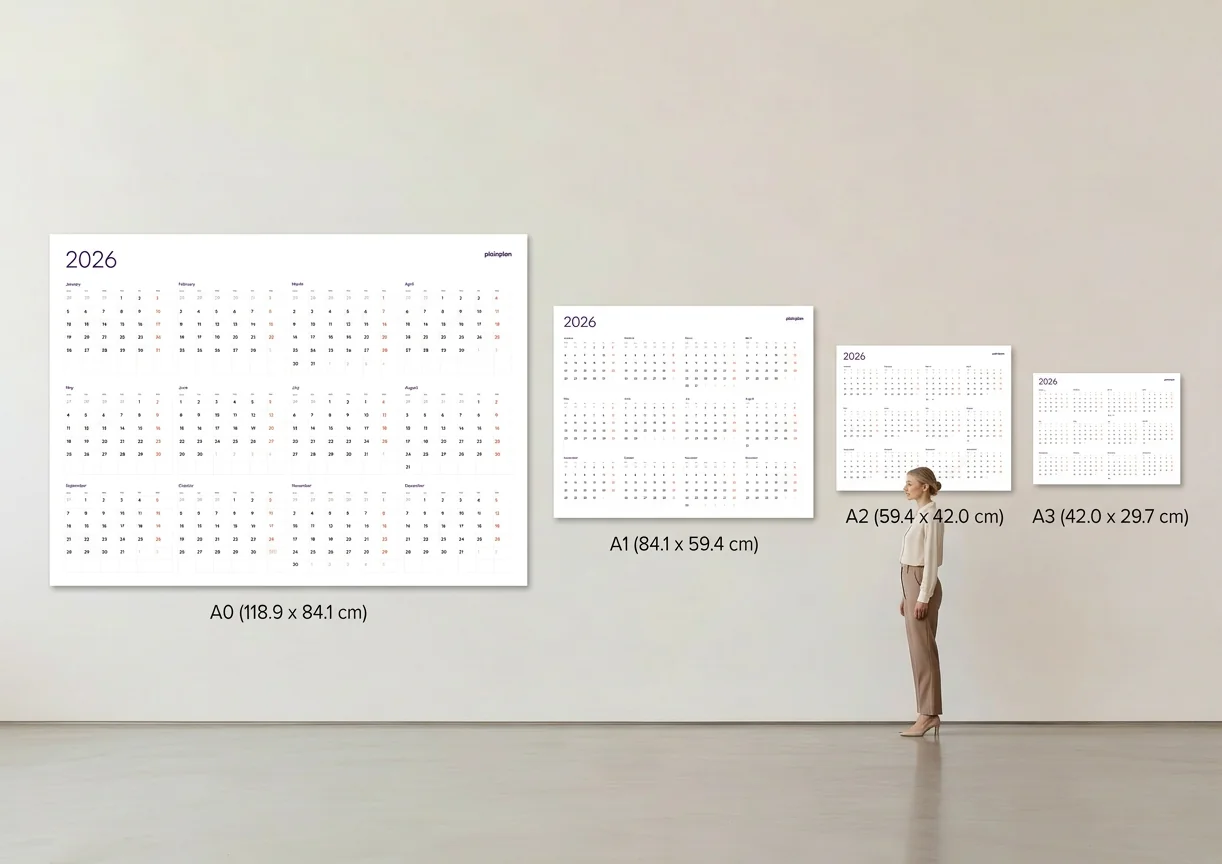
For sizes, US letter (8.5 × 11 in) and tabloid/ledger (11 × 17 in) are the common home printer sheets. Large-format poster printing at print shops typically goes 18 × 24 in (roughly A2), 24 × 36 in (roughly A1), and 36 × 48 in (roughly A0). If the planner PDF is sized to an ISO A dimension, the print shop can scale it to the nearest US poster size with no quality loss on a vector file.
Paper cheat sheet
For a wall planner: ask for 120–160 gsm (32–43 lb bond), matte finish, no scaling. If you want to write on it regularly, matte is the only finish that works reliably with pen. If you want to reuse it year after year, laminate it and use dry-erase markers.
Avoid 80 gsm — it’s too flimsy for wall hanging. Avoid glossy unless the calendar is purely decorative and you never plan to annotate it. Above 160 gsm, you’re paying more for no practical gain on a flat wall planner.
One last note on vector PDFs: a well-made printable planner is a vector file, which means lines and text are stored as mathematical paths rather than pixels. Vector files can be scaled to any size — from A4 to A0 — without any softening or pixelation. The only thing standing between you and a sharp, professional-looking wall calendar is the paper you choose. Read our guide to vector PDFs for the full explanation.

Frequently asked questions
120–160 gsm (32–43 lb bond) is the sweet spot. It’s stiff enough to hang flat without a frame, takes handwritten notes, and won’t curl at the corners. Standard 80 gsm copy paper is too flimsy for wall use.
Not reliably. Ink beads up on glossy paper and smears. Matte is the only finish that takes ballpoint, gel, or fine-liner without smudging. If you want glossy for its look, laminate over matte and use dry-erase markers instead.
GSM stands for grams per square metre — the international measure of paper weight defined by ISO 536. For bond paper, divide the gsm figure by 3.76 to get the lb bond equivalent. So 80 gsm ≈ 20 lb bond, 120 gsm ≈ 32 lb bond, 160 gsm ≈ 43 lb bond.
Yes, if you want to reuse it. Lamination turns the surface into a dry-erase board. Ask for matte laminate, not glossy — glossy laminate creates glare and still can’t be written on with a regular pen.
Sources
- ISO 536 Paper Weights: 80 gsm, 90 gsm, 120 gsm — US & Canada 20 lb, 24 lb — PaperSizes.org
- Paper Weight Guide: Understanding Thickness and GSM — PaperPapers
- Paper Weight Conversions: LBS to GSM — Solo Printing
- Differences: Glossy vs. Matte Prints — Printivity
- Matte vs. Glossy Finish: What’s Better for Print? — VistaPrint
Print your year.
One file. Any wall. Always sharp.