
One-Page 2027 Calendar: Why Your Whole Year Belongs on a Single Sheet
Month-by-month calendars hide the conflicts that matter most. A one-page 2027 calendar gives you the spatial context to see your whole year before it happens.
What a one-page calendar actually shows you
Most people flip through calendars one month at a time. January. February. March. Each month is a fresh page, a clean slate, a little island of dates. It feels organised. It isn’t.
The problem with month-by-month calendars is that deadlines don’t respect month boundaries. A project due in October starts in July. A trip you booked in April conflicts with a conference you forgot about in September. When you can only see 30 days at a time, these collisions are invisible until they’re urgent.
A one-page 2027 calendar - all 12 months on a single sheet - fixes this not by giving you more boxes, but by giving you more context. The value isn’t information density. It’s spatial relationships. When every month is visible at once, you see things that month-by-month views hide: how many weeks sit between two deadlines, where the genuine empty stretches are, which quarters are already packed before you add anything.
Birthdays, school terms, product launches, vacations - on a single sheet, their positions relative to each other are immediately obvious. You stop thinking “that’s months away” and start thinking “that’s only six weeks after this other thing.” Surprises - the kind that make you say “how did I not see that coming?” - rarely appear on a full-year view. They hide in the gap between page 3 and page 4 of a monthly planner.
Ambient visibility vs. scheduled checking
There’s a distinction worth making between two ways of knowing your schedule. The first is scheduled checking: you open an app or flip to a page when you need to look something up. The second is ambient visibility: the information is always in your peripheral vision, and you absorb it without trying.
A phone calendar is scheduled checking. You pull it out, navigate to the right month, find the date. A wall calendar is ambient visibility. You walk past it every morning and your brain quietly registers what’s coming.
Research published in the Journal of Consumer Psychology in 2023 found that paper calendar users completed 53% of their plans compared to just 33% for digital calendar users - largely because the physical format encourages a broader, big-picture perspective during planning. Writers and thinkers who do long-horizon work tend to keep their year visible in exactly this way: not because staring at a calendar makes you productive, but because ambient awareness of your schedule prevents the reactive mode that kicks in when deadlines appear from nowhere.
Cal Newport, whose work on deep work scheduling is well documented on his blog, argues that protecting long blocks of focused time requires knowing in advance where the year’s interruptions are concentrated. A printed one-page calendar on your wall is the cheapest, most reliable version of that awareness. If you want to understand the full-year method, the year-at-a-glance setup guide covers the pre-fill ritual and quarterly review habit in detail.
How people actually use a full-year view
The most common use is annual review and quarterly planning. At the start of the year, you block out the non-negotiables - school holidays, known travel, recurring events - and see immediately how much working time remains. Quarterly milestones become obvious when you can see all four quarters side by side.
Deep work scheduling is another strong use case. If you’re trying to protect long blocks of focused time, you need to see where the interruptions are concentrated. Two conference trips in Q3 might mean you schedule the biggest project for Q1 and Q2, not October. For a deeper look at this approach, see the article on using a wall planner for annual review.
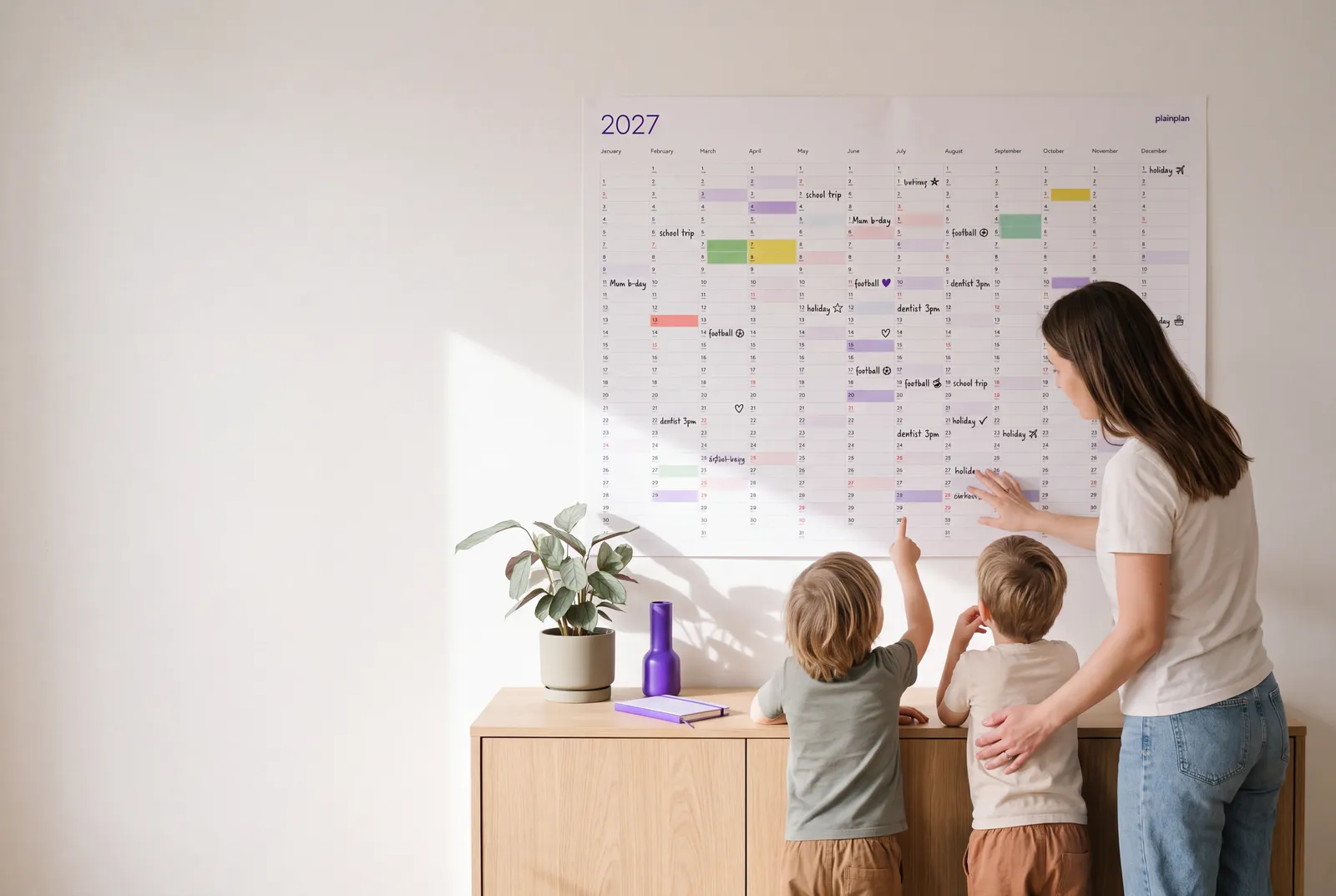
Families use it differently: school terms, activities, custody schedules, holidays. The kitchen wall is the only place everyone in the house sees the same information without anyone having to manage a shared app. Some households combine it with a family command centre setup for maximum visibility.
In all these cases, the value is the same: seeing what’s already claimed before you commit to something new. Compare this to a yearly planner versus a monthly calendar and the advantage of the full-year format becomes immediately clear.
Vertical vs. Square layout: which works for a single sheet
plainplan comes in two layouts: Vertical and Square. Both fit on one sheet. They make different trade-offs.
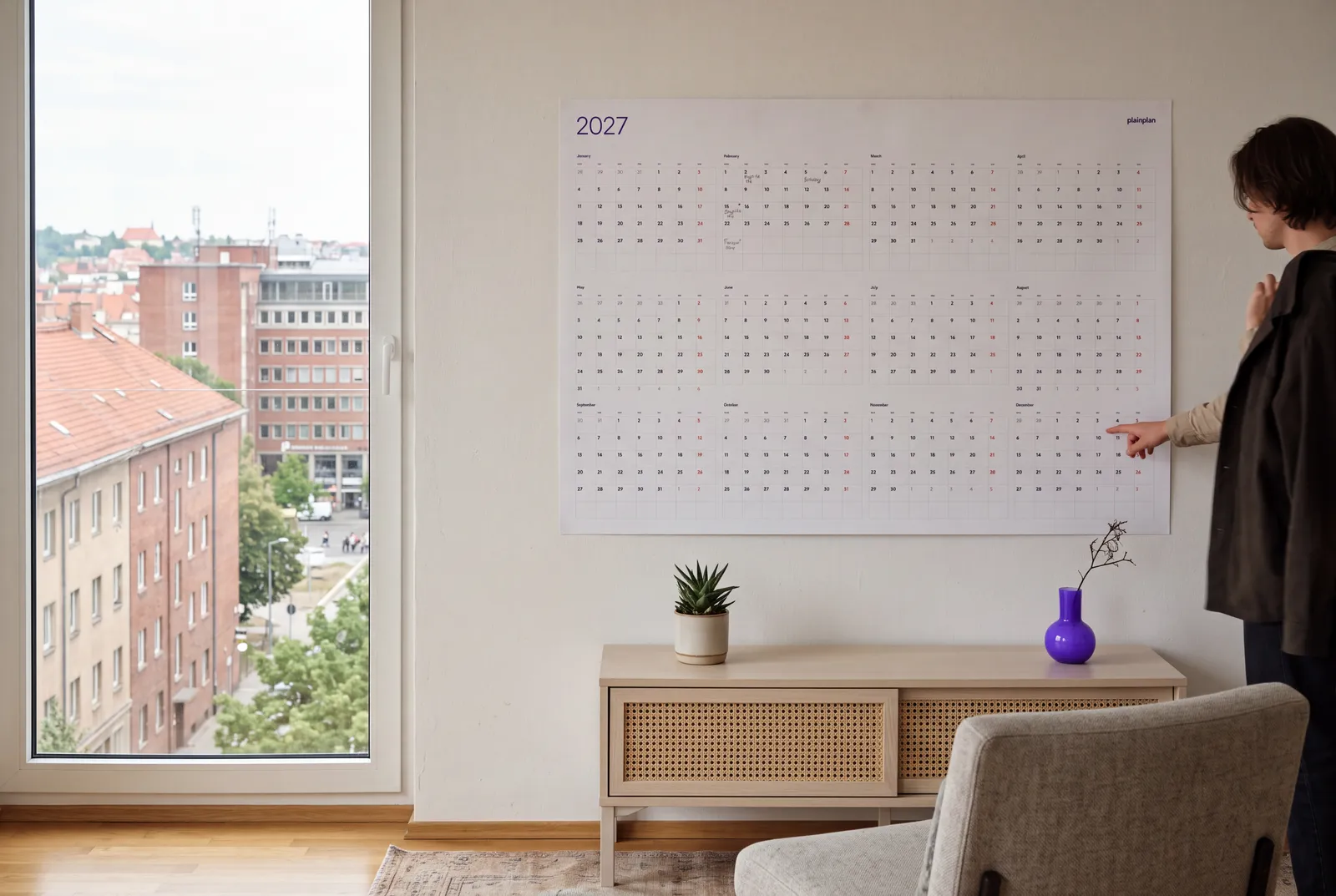
The Vertical layout runs months left to right, with days flowing downward inside each column. This puts the whole year in a long horizontal band. It’s easy to scan across months - useful for spotting long-term gaps and patterns. It works best at A2 or A1, where the horizontal span gives each month room to breathe.
The Square layout arranges months in a grid - typically three or four columns. It’s more compact and works better at A3 or A2 when wall space is limited. The trade-off is that cross-month scanning requires more eye movement.
For a full-year command centre - something you actually scan every day - the Vertical layout at A1 or A2 is the stronger choice. For a desk reference or a smaller wall, Square at A3 is clean and legible.
Try 2026 for free
before you buy 2027
One file. Any wall. Always sharp.
Paper size guide: what to print for your wall
plainplan is a vector PDF, which means it prints sharp at any size. But which size you choose changes how it feels on a wall. For detailed instructions on printing at any size, see the guide on how to print a wall calendar at any size.
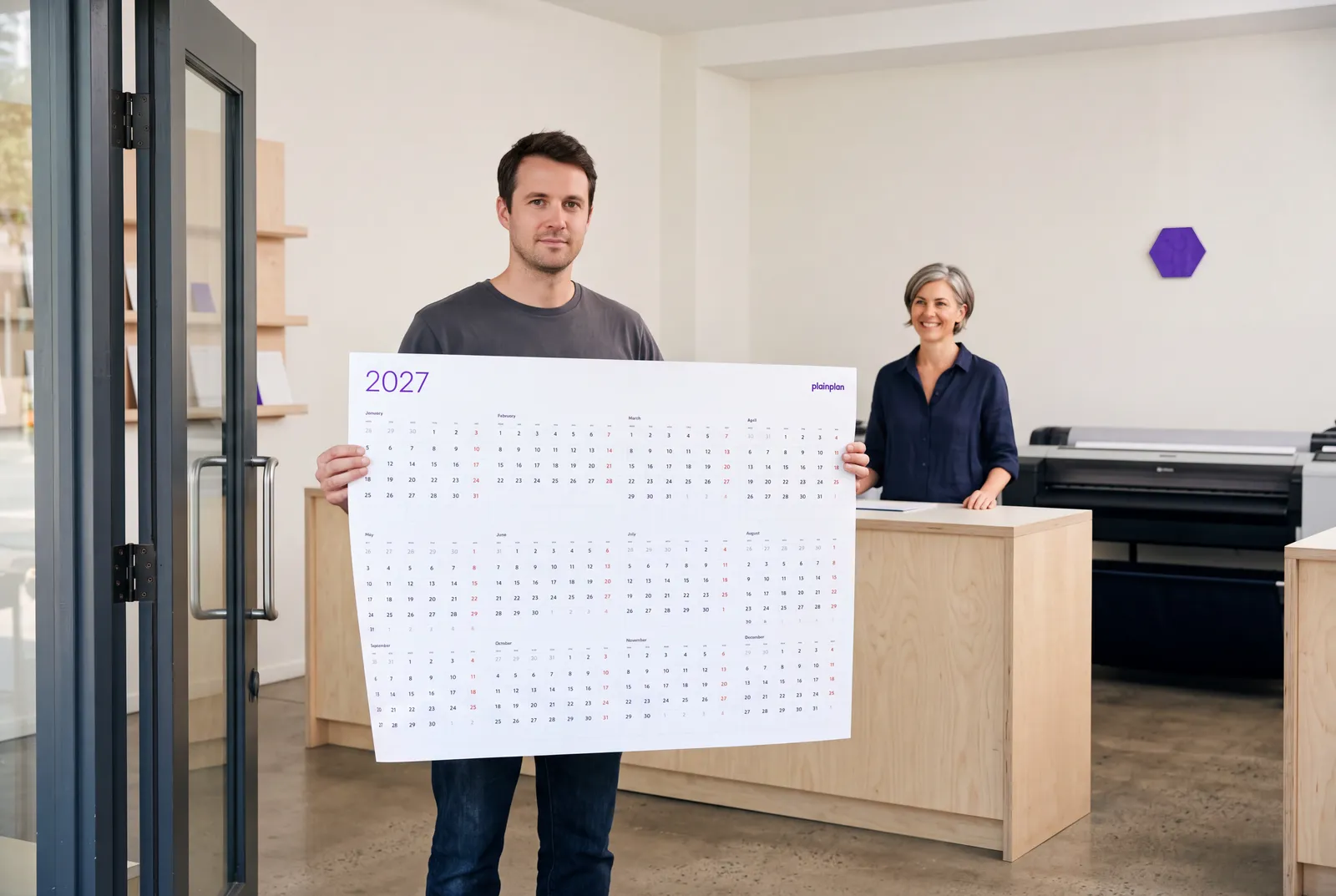
A4 (210 × 297 mm): fine as a desk reference or a supplement, but the day cells are small. Not ideal for daily wall use. A3 (297 × 420 mm): a good compromise for a small home office or kitchen. Readable from a metre away. A2 (420 × 594 mm): the sweet spot for most home walls. Big enough to read comfortably from your desk or kitchen table.
A1 (594 × 841 mm): the best choice for a command centre. Every day cell is clearly legible, you can write notes in pencil, and it’s visible from across a room. Most print shops can handle A1 on standard paper stock for a few euros. If you’re printing at home, A3 is the maximum size most home printers support. For A2 or A1, a local print shop or online print service - PDF upload, pick your paper, collect the same day - is the easiest route.
Why 2027 is worth planning now
Printing a 2027 calendar in late 2026 or early 2027 isn’t obsessive forward planning. It’s the opposite of last-minute. The earlier you put the full year on a wall, the more decisions you make with context rather than in reaction.
The cost of getting it wrong is low. One sheet of paper, a couple of minutes at a print shop. The cost of flying blind through a year - overcommitting quarters, missing windows, discovering conflicts when it’s already too late to adjust - is much higher.
A one-page 2027 calendar doesn’t plan your year for you. It makes sure you can see what you’re planning.
Frequently asked questions
A one-page 2027 calendar is a printable sheet that displays all 12 months of 2027 on a single page. Unlike month-by-month wall calendars, it shows every deadline, trip, and milestone in relation to each other - so you can spot conflicts and gaps before they become problems.
A2 (420 × 594 mm) is the sweet spot for most home walls - readable from your desk or kitchen table. A1 (594 × 841 mm) is best for a command centre where you need to read it from across the room. A3 works as a compact desk reference. plainplan is a vector PDF, so it prints sharp at every size.
The Vertical layout runs months horizontally across the sheet with days flowing downward - ideal for scanning across months at A2 or A1. The Square layout arranges months in a grid, which is more compact and works well at A3. For a daily wall reference, Vertical is the stronger choice.
As early as possible - ideally in Q4 2026 or at the very start of 2027. The whole benefit of a full-year view is making decisions with context rather than in reaction. The earlier your year is on the wall, the more conflicts you catch before they become emergencies.

Sources
- Huang, H. et al. (2023) - How using a paper versus mobile calendar influences everyday planning and plan fulfillment - Journal of Consumer Psychology (Wiley)
- Newport, C. - Deep Habits: The Importance of Planning Every Minute of Your Work Day - Cal Newport
- Newport, C. - Milton Friedman’s Deep Work Seasons - Cal Newport
- Defying the Digital Age: Using a Paper Calendar Could Make You More Productive - Columbia Business School