
Planting Calendar on the Wall: The Garden Year on One Sheet
Sowing dates live in seed packets, on the back of a notebook and in three apps. The garden does not check any of them. A wall planner in the shed puts the whole growing year where the trowel is - and a blank one takes your climate, not a template's.
Why a printed calendar beats a planting app in a shed
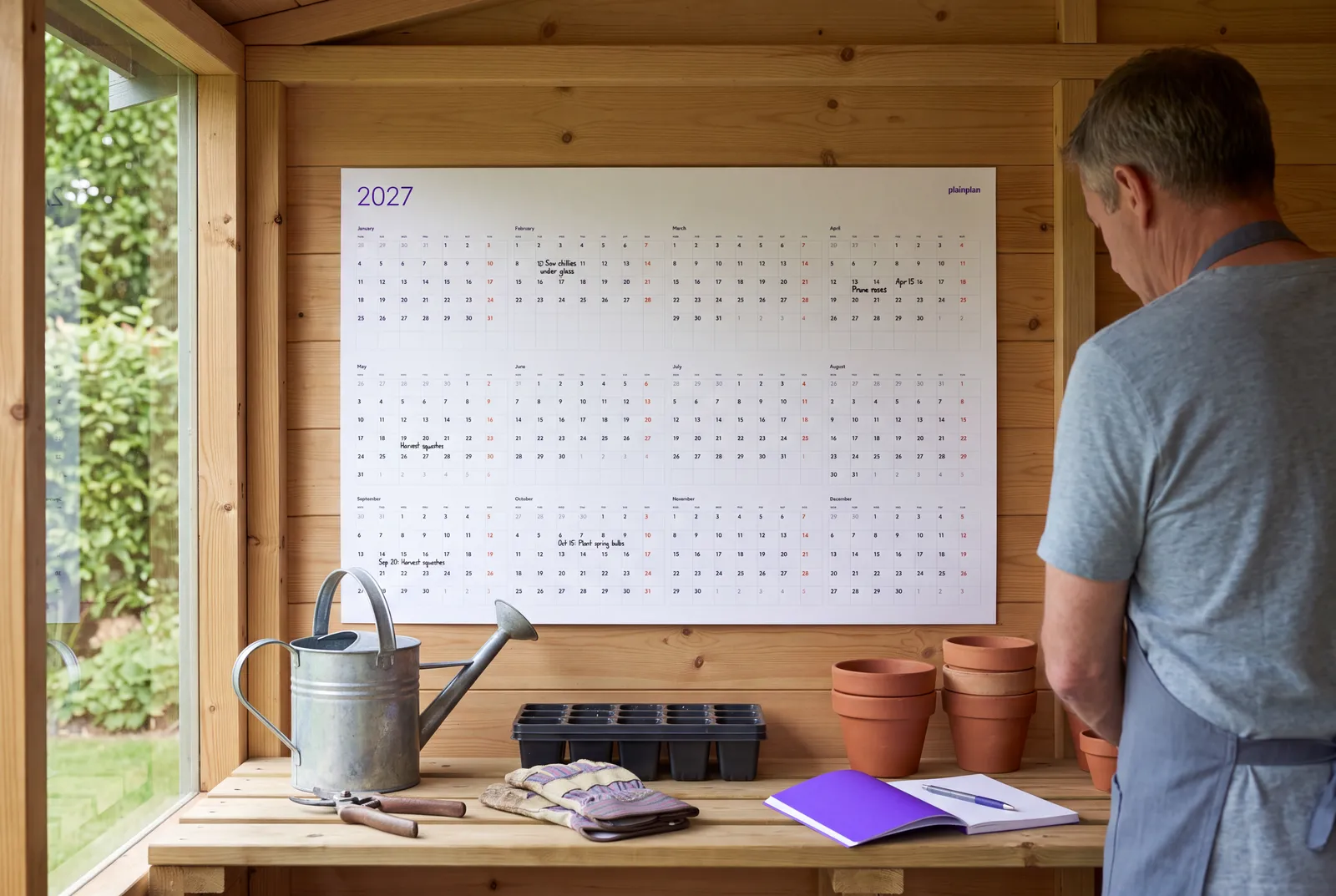
Every gardener has a planting calendar somewhere. The problem is where: a phone with muddy gloves on, a laptop in the house, a chart from a seed company that assumes a climate two zones away. The place a planting calendar earns its keep is on the wall of the shed or greenhouse, at eye level, readable with a coffee in one hand.
plainplan is not a gardening calendar and that is the point. It is a blank year - no moon phases, no printed sowing windows for a region that is not yours - so what goes on it is your last frost, your beds, your seeds. The grid is the same one an office uses for deadlines; the garden just writes different things in it.
Start from your last and first frost
Two dates decide the whole year: the average last spring frost and the average first autumn frost for where you actually live. Write them on the planner first, in a colour you use for nothing else, and draw a line across each. Everything tender goes out after the first line and comes in before the second. Everything hardy ignores them.
If you do not know your dates, your national meteorological service or a local growing society publishes them by region; note the year you looked them up, because they shift.
Sow, plant out, harvest: three marks per crop
For each crop, three marks in one colour: a dot on the sowing date, a bar over the planting-out window, a bracket over the expected harvest. Tomatoes, beans, garlic, salad - each gets a colour, and a legend in the corner names them. The Vertical layout suits this best: months side by side, so a crop that runs from a March sowing to an October harvest reads as one line across the wall.
Write the variety next to the first dot. In August, when the second sowing of one lettuce bolts and the other does not, that note is the difference between knowing why and guessing.
Try 2026 for free
before you buy 2027
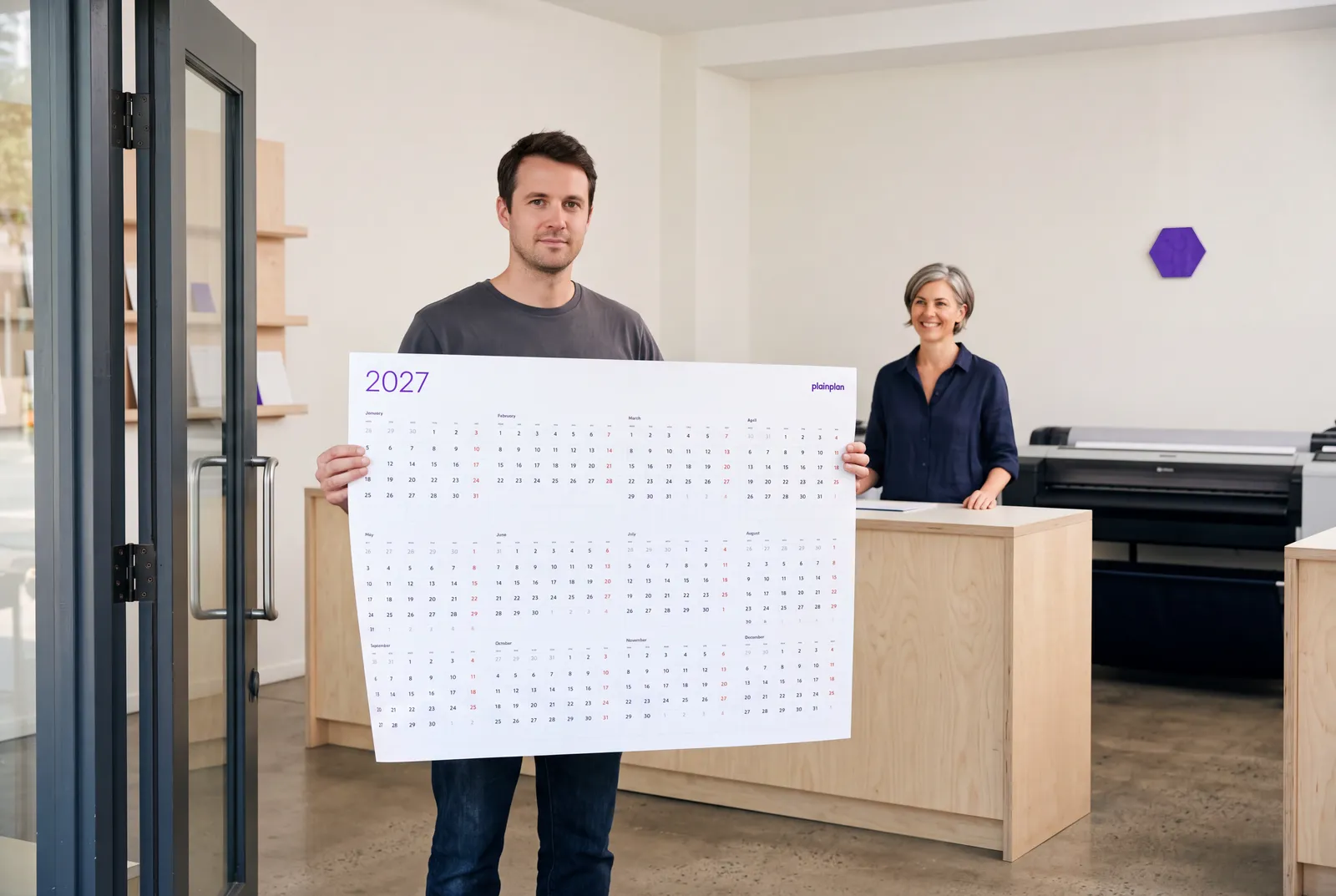
A blank year, your frost dates, your seeds. The same file hangs in a kitchen, an office or a greenhouse - print it at the size the shed wall allows.
Succession sowing without the spreadsheet
The reason salad runs out in July is that it was all sown in April. On the wall, succession sowing is just the same dot repeated every two or three weeks along the row - and the gaps are visible in a way a list never shows. Mark the last sensible sowing date for each crop as a small cross, so the plan stops itself before the frost does.
Garlic, onion sets and broad beans go in before winter; put their dots in October and November now, or next year's calendar starts with an empty bed.
Where to hang it and what to print it on
Sheds are damp and greenhouses are worse. Print at A2 or A1 - big enough to read from the potting bench - and have the copy shop laminate it; a laminated sheet takes a dry-erase marker and shrugs off a wet glove. Screw it to the back of the door or the one wall that stays dry. The paper guide covers weights and lamination; the size guide covers what fits.
A second, unlaminated copy in the kitchen is worth the extra few euros: the one in the shed is for doing, the one in the kitchen is for planning over breakfast.
Next year is the same file
The garden year does not reset, it repeats with corrections. Photograph the sheet in November, print next year's planner, and copy across the things that worked - and the crosses where they did not. Three years of that and you have a planting calendar for your exact plot, which no seed company can print for you.
Frequently asked questions
No. Sowing windows depend on your climate, and a calendar with the wrong region printed on it is worse than a blank one. You write your own frost dates and crops in once.
Vertical. A crop runs from sowing to harvest across months, and the Vertical grid shows every month side by side so that reads as one continuous line.
Laminated, yes - it takes damp, condensation and dry-erase markers. Unlaminated paper will curl within a season, so keep that copy in the kitchen.
A2 for a small shed read from a bench, A1 if the wall allows it. The vector PDF prints sharp at either without a different file.
