
Dry-Erase Calendar vs Printable Wall Planner: Which One Actually Gets Used?
A whiteboard calendar promises endless reuse. A printed planner promises a whole year at once. Both hang on a wall; only one of them shows you October in March. An honest comparison, including the cases where the whiteboard wins.
What each one is for
A dry-erase calendar is a board with a month grid printed on it: you write the dates in, fill the month, wipe it and start again. A printable wall planner is a file you print once a year at whatever size the wall allows, with the whole year on the sheet. They look similar in a photo and behave completely differently on a wall.
plainplan is the second kind - a blank year with big day cells, no imagery, no printed instructions - so this comparison is not neutral. It is, though, honest about where the board is the better tool, because a whiteboard bought for the wrong reason ends up as blank as a calendar bought for the wrong reason.
The month problem
Almost every dry-erase calendar is a single month. That is the constraint everything else follows from. In March you can see March; the wedding in June, the exam in May, the delivery due in September are all somewhere else - a phone, a notebook, memory. The board is excellent at this week and useless at this year.
A printed yearly planner is the opposite. All twelve months are on the wall at once, so a plan made in January is still visible in April, and the gap between two events is a distance you can see rather than a number you have to calculate. That single difference decides most purchases: if what you need to see is a month, buy the board; if it is a year, print the year.
Writing, erasing and the record
Erasing sounds like the advantage and is often the flaw. What was on the board in February is gone by March - no record of when the boiler was serviced, when the last order went out, when the training block started. A printed planner is written in pen; changes get a line through them, and at the end of the year the sheet is a record of what actually happened, which is worth more than most people expect.
The board wins for things that genuinely change daily: a shop rota, a kitchen's specials, a team's stand-up board. Ink on paper wins for anything that should still be true next month.
Try 2026 for free
before you buy 2027
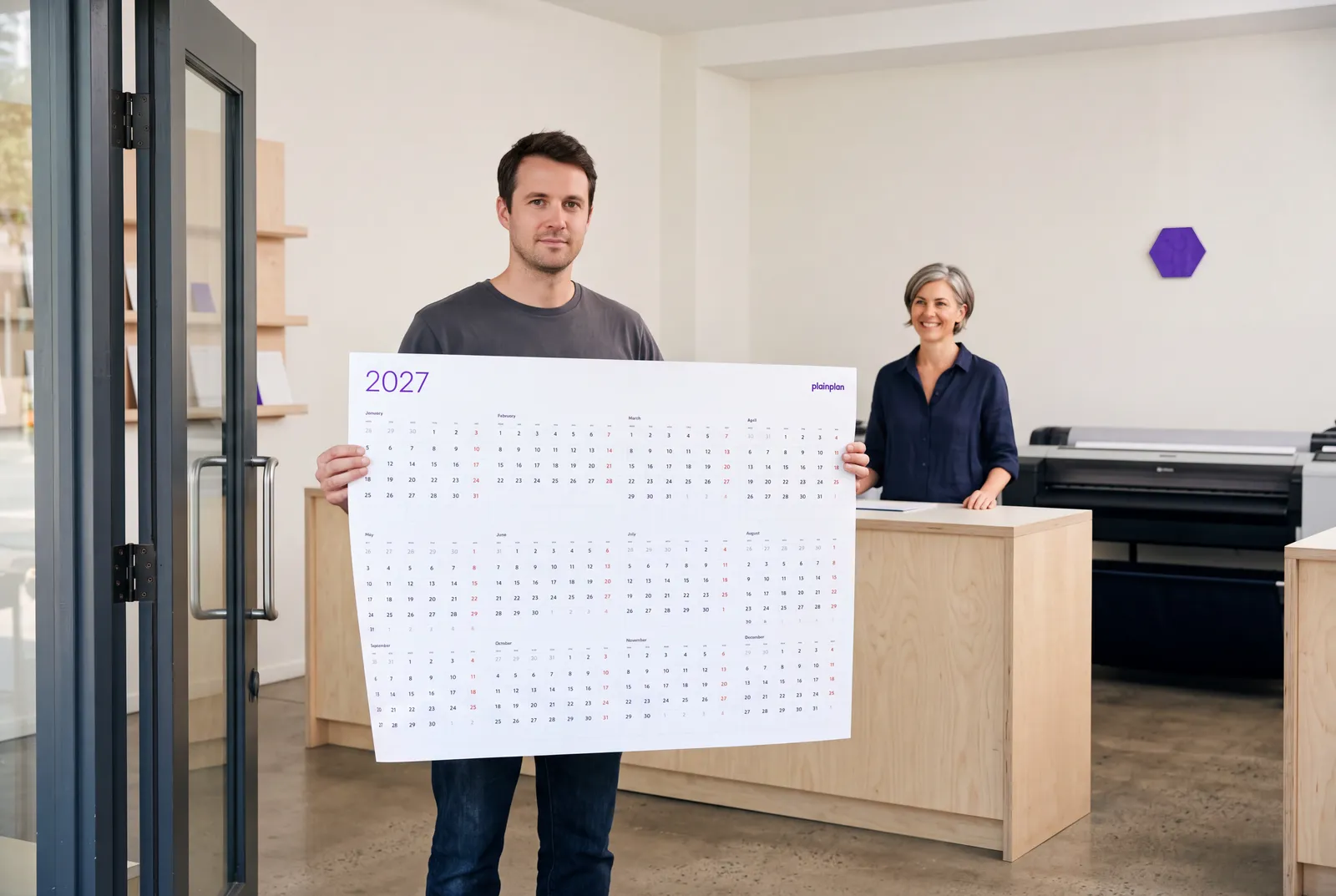
A blank year, printed once, written on for twelve months. Try the free 2026 planner and decide whether you need the board at all.
Size, cost and the wall
A dry-erase month board of decent size costs somewhere between a meal out and a small appliance, and it is a fixed size forever: the board you bought is the board you have. A printed planner costs the price of the file plus the print, and the print is whatever the wall needs - A3 at home this year, A1 at a copy shop next year, without buying anything again. The size guide has the reading-distance test for choosing.
Weight matters too. A large board needs proper fixing into a wall; a printed sheet hangs on two pins or a strip of tape, and moves rooms in a minute.
When the whiteboard wins
Three cases, honestly. A rota that changes every week, where a pen would mean a new sheet each Friday. A shared family board for this week's meals and pickups, where the year view is overkill. And anywhere you need to erase in front of other people - a classroom, a kitchen pass, a workshop floor. In all three the board is the right tool and a printed year is not.
The compromise that works for many homes and offices is both: a laminated printed planner for the year, written on with a dry-erase marker, and a small board for this week. The planner does the planning and the board does the noise.
When the printed year wins
Everything with a horizon longer than a month. Holidays and leave, school terms, a training block, a garden, a product launch, a wedding, a renovation. Anything where seeing the whole year changes decisions - and anything where the sheet at the end of the year is worth keeping. That is most planning most people do, and it is the planning a month board cannot show.
If you are unsure which you are, the free 2026 plainplan is the cheap experiment: print it at A3 on a home printer, pin it up, and see whether you look at October in March. If you do, you needed the year.
Frequently asked questions
Yes, if it is laminated at the copy shop - then it behaves like a board with the whole year on it. On plain paper, use a pen or a fine marker.
Usually. The 2026 file is free and 2027 costs less than most boards; an A2 print at a copy shop is a few euros. A board is a one-off purchase but fixed in size.
No, but the Square layout is the classic monthly grid, all twelve months on one sheet. It is the closest thing to a whiteboard calendar that still shows the year.
Same month problem, higher price. They are furniture first and calendars second, which is fine if that is what you are buying.
