
Academic Year Wall Planner 2026-2027: Setup for Teachers and Students
The academic year does not start in January - it starts in September and runs to July. Here is how to set up a wall planner around terms, half-terms, and exam season, whether you are running a classroom or your own study.

The Academic Year Is Not the Calendar Year
Most wall planners are built for the calendar year - January to December. For anyone in education, that is the wrong shape. Your year starts in September and ends in July, with the summer as the reset between one year and the next. A January-to-December planner splits every school year across two sheets, which is exactly why so many teachers and students give up on wall planners after a term.
An academic year planner is set up to run September 2026 to August 2027 as a single view. The whole arc - autumn term, spring term, summer term, and the exam season that closes them - sits on one wall, in order, at a distance you can read across a classroom. That single continuous view is the point: you see how close the mock exams are to the Christmas break, how little teaching time sits between February half-term and the Easter holidays, and where the pressure genuinely builds.
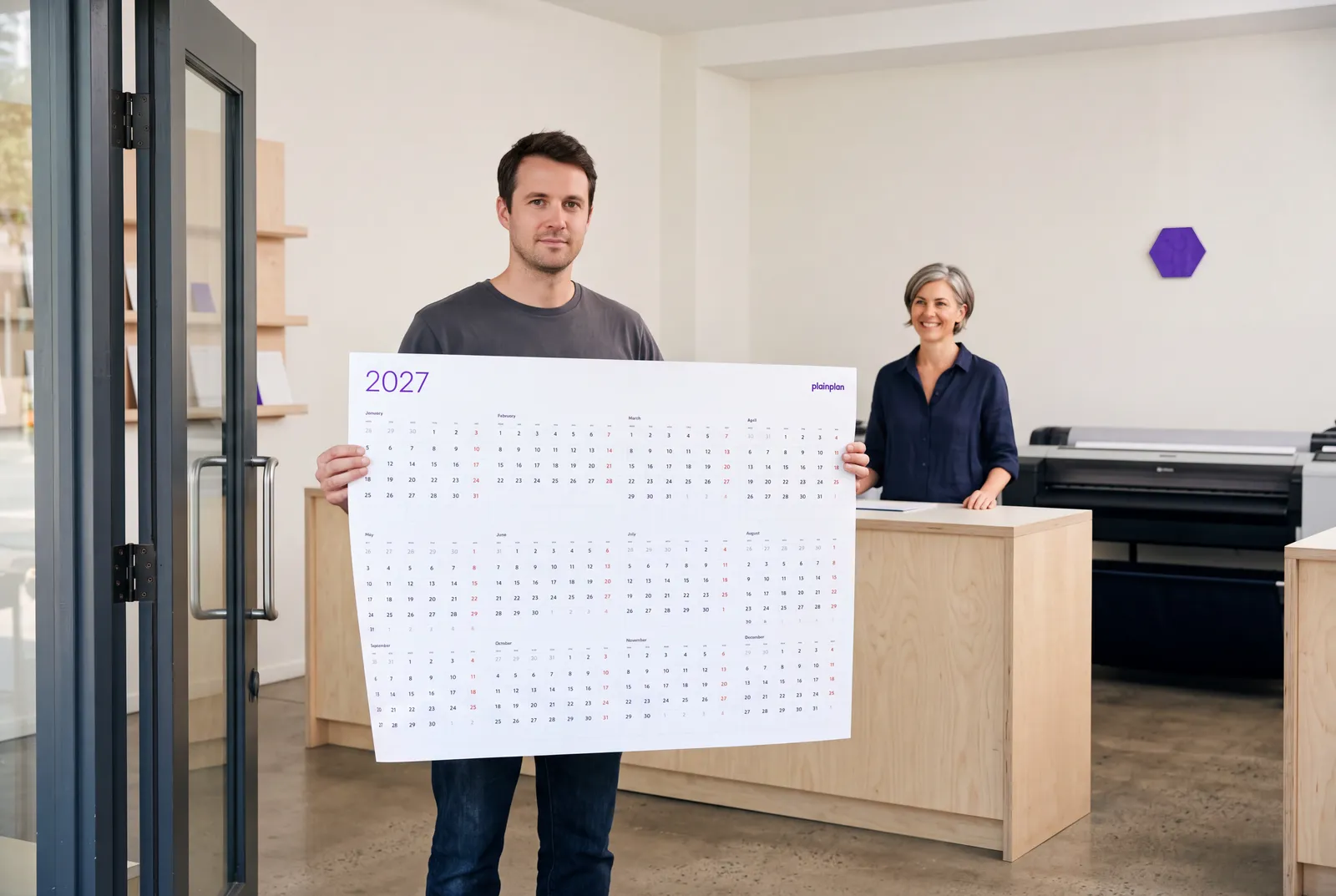
Because plainplan is a vector PDF, you set the start month when you print - there is no fixed January-first assumption baked into a fixed-resolution image. You print the year you actually work to, at the size your wall allows, and it stays sharp from A3 to A0.
Print and Mount: Classroom, Desk, or Study
Size follows the room. For a classroom display that pupils read from their seats, A1 is the honest minimum - anything smaller cannot be read from the back row, and a planner nobody can read is wall decoration. For a teacher’s own desk or a student’s study, A3 is the practical floor and A2 is comfortable for writing with a normal pen.
Position decides use. Hang it on a wall you pass every day - beside the whiteboard, above a desk, on the back of a study-room door you actually leave open. The planner works passively: you glance at it while the kettle boils or the class settles, and the parents’ evening two weeks out registers without any deliberate check. A planner you have to seek out is a planner you will forget.
Mounting: command strips avoid holes on painted classroom walls, a poster frame looks finished for a shared staffroom, and masking tape is fine for a trial fortnight before you commit to a spot. Get it level - a crooked planner is distracting enough to reduce how often people look at it.
Map the Terms First: The Fixed Skeleton
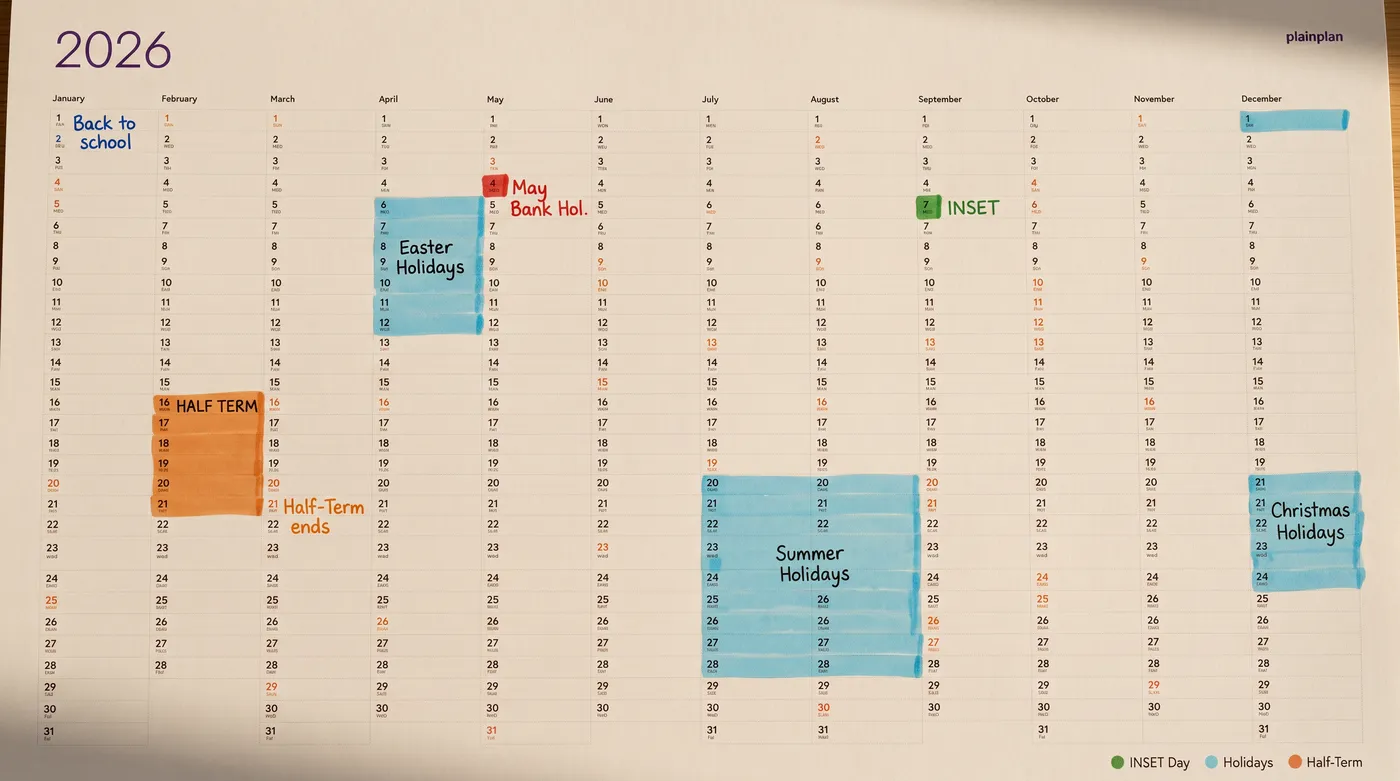
Before anything else goes on, block out the structure of the year. In England, term dates are set by local councils and academies rather than nationally, so the exact days vary between schools - always take yours from your school calendar or your council’s published dates. The shape, though, is consistent: three terms, each split by a half-term break, with the long summer holiday between years.
Mark, in this order: the three term start and end dates, the three half-terms, the Christmas, Easter, and summer holidays, and any bank holidays that fall in term time. Then add the INSET or training days your school runs - these are easy to forget and awkward when a parent turns up expecting a normal school day. This skeleton is the part of the planner that everything else hangs from.
Keep the exam window visible even before the exact dates are confirmed. Public exams in England run through May and into June, with results in the following August; you can block the season now and pencil in precise dates once the boards publish them. Seeing that window from September changes how the autumn and spring are paced - it stops the summer term from arriving as a surprise. For the wider setup logic behind this, see How to Use a Wall Planner.
For Teachers: The Classroom Command Centre
For a teacher, the wall planner is where the year’s fixed commitments become visible to the whole class at once. Once the term skeleton is in, add the dates that shape your teaching: assessment and mock windows, report deadlines, parents’ evenings, trips and off-timetable days, and any whole-school events that eat into lesson time.
Used at the front of the room, it also does quiet work with pupils. A visible countdown to a deadline or an exam changes behaviour more reliably than a reminder said once and forgotten - the date is simply there, every lesson, in the context of everything else that is coming. Marking coursework and assessment deadlines where the class can see them shifts some of the tracking off you and onto the room.
Keep your own layer light. Daily lesson plans, marking piles, and meeting times belong in your planner or your calendar app, not on the wall - the wall is for the fixed points that the class and your colleagues plan around. If a date matters to someone else’s planning, it earns a place on the wall; if it only matters to you on the day, it lives elsewhere.
For Students: Deadlines, Exams, and Revision
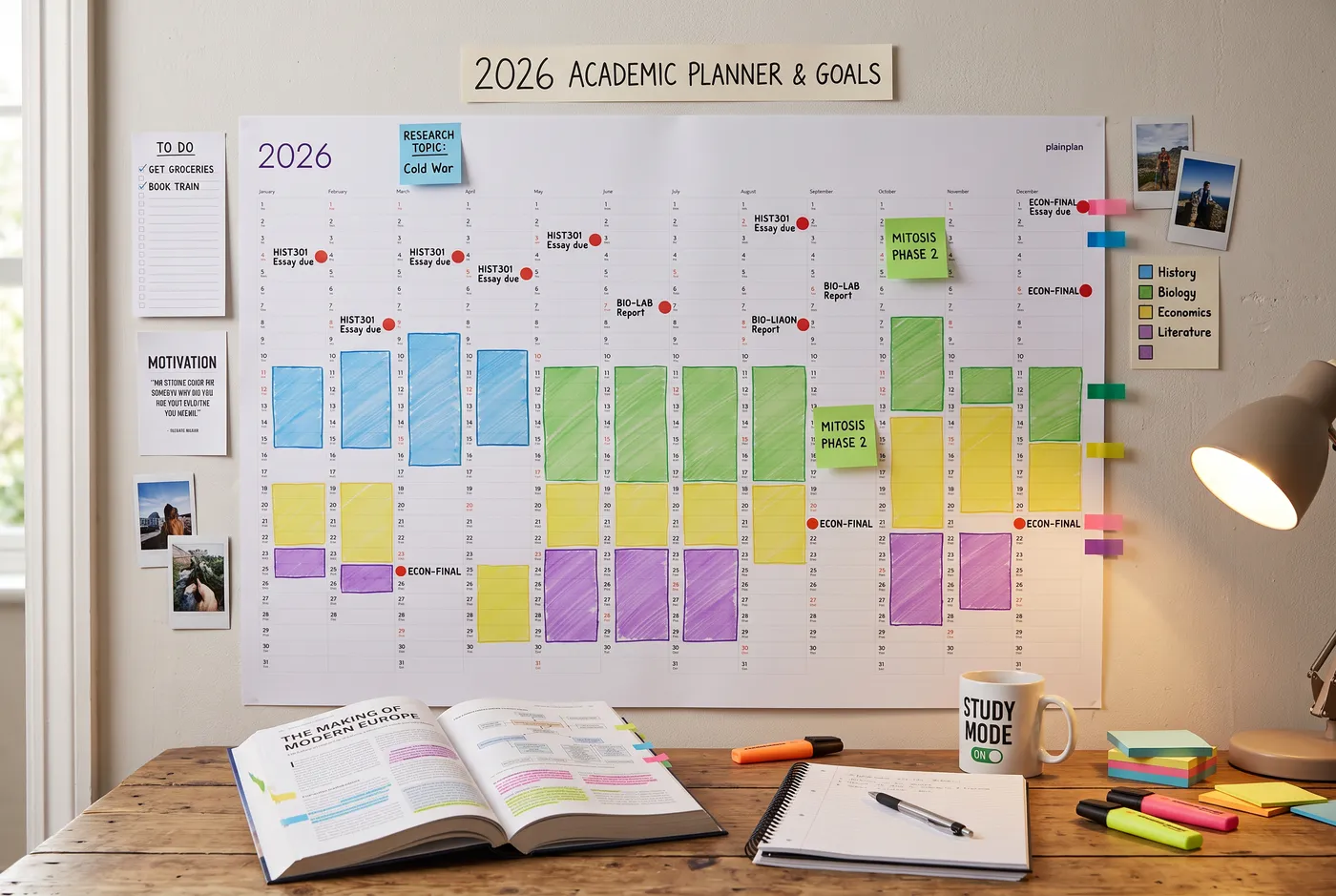
For a student, the value of an academic wall planner is that it makes deadline collisions obvious months before they happen. Put up every coursework and assignment deadline, the exam window, and any application dates - university, apprenticeship, or otherwise - and the clashes you would have discovered the hard way in April are visible in October instead.
Then plan backwards. A wall planner is unusually good at this because you can see the empty weeks between now and a deadline and block revision or drafting into them on purpose. Spacing that work out beats cramming it into the final week: decades of research on spaced practice show that the same hours spread across several weeks produce far better retention than the same hours the night before. The planner is what makes the spacing visible enough to actually keep.
Do not put daily to-dos on it. The wall planner holds the fixed dates - deadlines, exams, applications - and the revision blocks you have committed to. The day-to-day task list lives in a notebook or an app. Keeping the wall to the skeleton is what keeps it readable across a whole demanding year.
Try 2026 for free
before you buy 2027
One file. Any wall. Always sharp.
Colour-Code by Subject or Class
An academic year is dense enough that plain text runs out of room quickly. Colour is how you fit more onto the same wall without making it unreadable. Assign a colour to each subject, each class, or each category of date, and a full planner becomes something you can read at a glance from across the room.
Sensible schemes: a student can give each subject its own colour, so the balance of the term - and any subject that is quietly stacking up deadlines - is visible instantly. A teacher can colour by class or by type: assessments in one colour, admin deadlines in another, trips and events in a third. Keep a small legend in the corner so anyone else reading the planner can decode it.
Hold the number of colours down - four to six is the readable limit. Past that, the code becomes something you have to translate rather than something you take in at a glance, which defeats the point. Colour coding a wall planner goes into the full method if you want a system that lasts the year.
Keep It Alive Through Term: The Weekly Scan
The reason wall planners get abandoned is always the same: they are filled once in September and never touched again. The habit that prevents it is a weekly scan - five minutes, the same time each week, looking ahead rather than back. In a term that runs at pace, this is the single ritual that keeps the planner accurate enough to trust.
A good moment is the start of the working week - a Monday morning or a Sunday evening. Stand in front of the planner and read the next three to four weeks. What is coming that you have not prepared for? Is there a deadline that needs work started the week before? Is there a clash you had not noticed? Add any newly confirmed dates while you are there, rather than trying to update the planner the instant things change.
Five minutes is the right length. Longer than ten and it turns into a planning session, which is a different job. The wall planner scan is a glance across the coming weeks, not a sit-down - and it is precisely that lightness that makes it survive a busy term.
Vertical vs. Square for Academic Use
plainplan comes in two layouts, and academic use has a slight lean. The vertical layout runs months top to bottom and reads well as a continuous flow - good for seeing the whole year sweep past and for portrait walls beside a whiteboard or door.
The square layout arranges the months in a grid, giving each month more visual weight. For anyone who plans in months rather than weeks - teachers working around term blocks, students mapping revision by month - this often reads more naturally, because within-month structure is easier to take in. For a fuller comparison, see Year at a Glance Setup.
If you are unsure, start vertical - it is the quicker format to read and the more forgiving for mixed use. Both layouts are included, so you can print one for the classroom and the other for your desk if they suit different jobs.
Frequently asked questions
In England the academic year runs from early September 2026 to July 2027, followed by the summer holiday. Exact term and half-term dates are set locally by councils and academies, so they vary between schools - take yours from your school calendar or your council’s published dates rather than assuming a national date.
A1 is the sensible minimum for a classroom display that pupils read from their seats; anything smaller cannot be read from the back of the room. For a teacher’s desk or a student’s study, A3 is the practical floor and A2 is comfortable. Because plainplan is a vector PDF, every size prints sharp - you choose by wall space and handwriting, not resolution.
Block the half-term breaks and holidays first as part of the fixed skeleton, then add INSET or training days as single marked cells - they are easy to forget and awkward when missed. A short colour or symbol code (for example, one colour for all non-teaching days) keeps them distinct from term-time events at a glance.
The skeleton is identical - terms, half-terms, holidays, and the exam window go on first for both. The layer on top differs: teachers add assessment windows, parents’ evenings, reports, and trips; students add coursework deadlines, exams, revision blocks, and application dates. Both keep daily tasks off the wall and in a notebook or app.
Because term dates are set locally in England, the reliable sources are your school’s published calendar and your local council’s term-date page (linked from gov.uk). Confirm exam dates with the relevant exam board. Block the seasons on the planner now, then pencil in exact dates as they are confirmed.

Sources