
Free Yearly Calendar Templates: When Free Works and When It Doesn’t
Free yearly calendar templates are everywhere and often good enough. Here’s the honest breakdown of when they work and when a paid vector PDF makes more sense.

What free templates actually look like
A search for “free printable yearly calendar 2027” returns thousands of results. Many of them are perfectly usable. Sites like Vertex42 and CalendarLabs offer genuinely clean A4 grids in PDF, Excel, and Word formats — free to download, no account required. If you need a simple calendar to print at your desk, you’ll find a good one in two minutes and spend nothing.
But some people download those free options, print them, and then pay for a different calendar anyway. This article is about why — not to convince you to pay, but to explain the three situations where paying makes practical sense.
Reason 1: Size
Almost every free printable yearly calendar is designed for A4 or US letter. That’s the default for a document you print at a home printer. It’s fine if the calendar sits on your desk or gets pinned to a corkboard close to eye level.
If you want a wall calendar you can read from across a room, you need A2 or larger. At that size, a raster-based A4 template — the kind built in Word or Canva — becomes visibly blurry. The grid lines soften, the type loses its edge, and it looks like something you printed and scaled up, which is exactly what happened.
Free vector yearly calendars exist, but they’re rare and often single-language or oddly formatted. If large-format print is your actual requirement, the free category mostly doesn’t solve the problem. That’s not a sales pitch — it’s the technical reality of raster vs. vector at print sizes. For a deeper explanation, see the case for vector PDF.
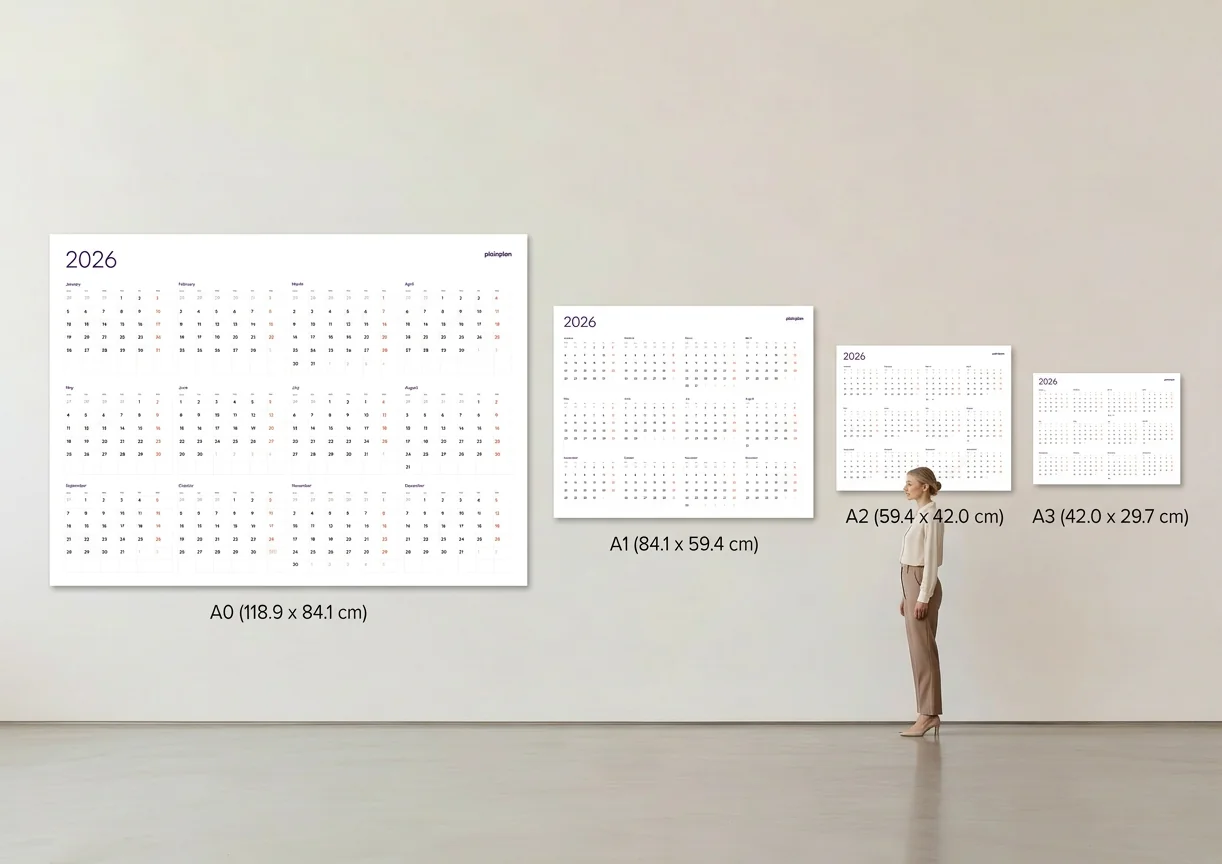
Reason 2: Appearance
For a calendar pinned above your own desk, aesthetics are personal. Print whatever works for you. But if the calendar is going on the wall of an office, a studio, or a classroom — or if it’s being given as a client gift — the visual quality of the template becomes a professional consideration.
Free templates vary widely. Some are genuinely clean. Others have inconsistent spacing, mismatched font weights, or grid lines that don’t align precisely across months. At A4 on a desk those issues are minor. At A1 on a wall they become obvious.
A designed product — one where someone made deliberate choices about grid proportions, type size, and line weight — holds together at large sizes in a way that a workaround template often doesn’t. If the setting requires the calendar to look considered, that distinction is worth a few pounds. If you’re comparing options, see also what makes a plain printable calendar actually useful.
Reason 3: Economics
This is a less practical reason but it’s honest. There is a segment of buyers who, given the choice between downloading the ten-thousandth free calendar from a content farm and paying $6.99 to a small independent product, prefer to pay. Not because the product is dramatically better, but because they’d rather the money go somewhere useful.
$6.99 is less than a coffee and a pastry at most cafes. If the alternative is downloading a template built specifically to harvest email addresses or page views, some people find the math straightforward.
This is a personal values call, not a universal argument. If you’re comfortable with the free option, use it. The free option often works fine.
When Free Is Right and When It Isn’t
If you need a calendar for your desk, want it quickly, and have no particular size or quality requirements, a free A4 printable is the right answer. There are genuinely good free annual calendar templates, and spending money you don’t need to spend is not a virtue.
If you need a large-format print that stays sharp at A2 or A1, need to print multiple copies without per-copy cost, or are putting it somewhere that requires it to look professional — those are the three cases where a paid, vector-based product earns its price. Not always PlainPlan specifically, but something in that category.
The calculus is simple: what size do you need, what will it be used for, and does the free option actually solve your problem? If you’re still deciding, this guide on how to use a wall planner covers what actually matters day-to-day. Start there.

Frequently asked questions
Most are. Sites like Vertex42 and CalendarLabs offer genuine free downloads with no account required. Some require an email sign-up or show ads — read the page before downloading if that matters to you.
Most free templates are designed for A4 or US letter and are raster-based, meaning they were created at a fixed resolution. Scaling them up to A2 or larger will produce blurry output. You need a vector-based file (PDF built from vector graphics) to print sharply at large sizes.
For desk use, PDF or Word is fine. For large-format printing, look for vector PDF specifically — not a PDF that was exported from a raster image. Most free templates don’t specify this, so the safe assumption is raster unless stated otherwise.
For desk use, probably not — a free A4 template does the same job. PlainPlan earns its price for large-format wall printing, where vector quality matters, and for people who want a clean minimal design without having to evaluate dozens of free options.
Sources
Your year. Your wall.
One file. Any wall. Always sharp.