
Branded Calendars as Corporate Gifts
Most branded gifts are used once and then live in a drawer. A wall calendar is one of the few that has a job to do, which is why it stays up. Here is what makes one worth giving, and what it actually costs to produce.
The Gift That Ends Up in a Drawer
Every December the same objects circulate between companies. A branded mug, a branded notebook, a branded power bank, a bottle of wine with a sticker on it. They are pleasant to receive and almost none of them get used more than once. The mug loses to the one the person already likes. The notebook loses to the phone. The power bank goes into the drawer with the other three power banks.
This is not a failure of taste. It is a failure of fit. A gift only survives if it does something the person was already going to do, and most branded objects are competing against something the recipient has already chosen for themselves.
That is the bar worth measuring a corporate gift against, and it is a harsh one: not “is it nice” but “does it replace something, or does it just add to the pile”.
A Calendar Has a Job to Do
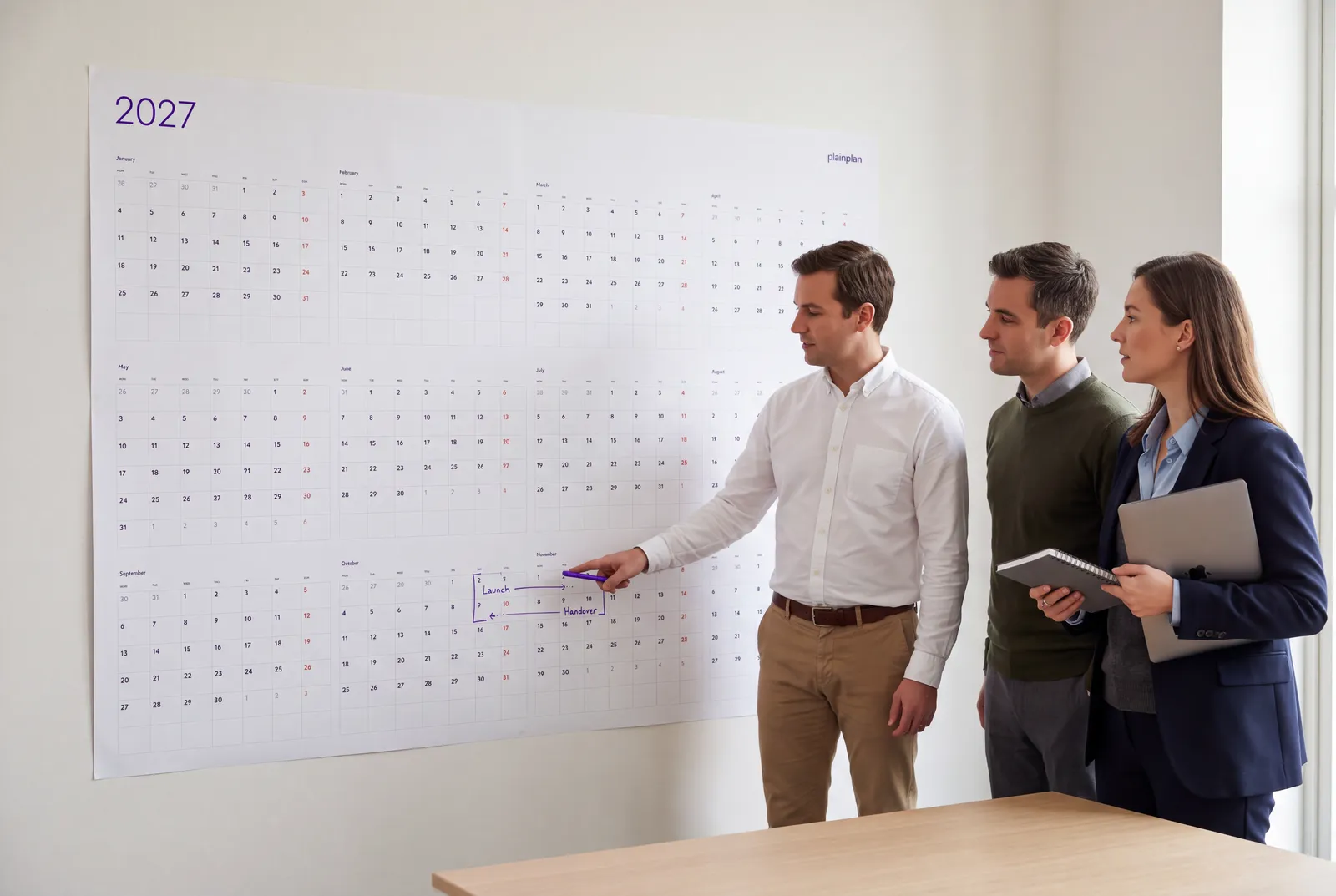
A wall calendar clears that bar for one specific reason: the wall it goes on is usually empty, and the job it does is one nobody has solved on a phone. Digital calendars are excellent at reminding you about the next hour and terrible at showing you the shape of the next nine months. That is why planning walls exist in offices that run everything else in software.
The consequence for a gift is the part most people miss. A mug gets a few seconds of attention a day, in a kitchen, with the logo facing whichever way it landed. A wall calendar sits at eye level in a room where people work, and it is looked at deliberately, several times a day, for twelve months. If your logo is on it, that is a year of quiet presence in a place your competitors are not.
There is also a selection effect worth noticing. The kind of company that puts a year planner on the wall is a company that plans, and those are usually the clients you want more of. A gift that only appeals to organised people is not a weakness. It is targeting.
What Makes a Branded Calendar Work
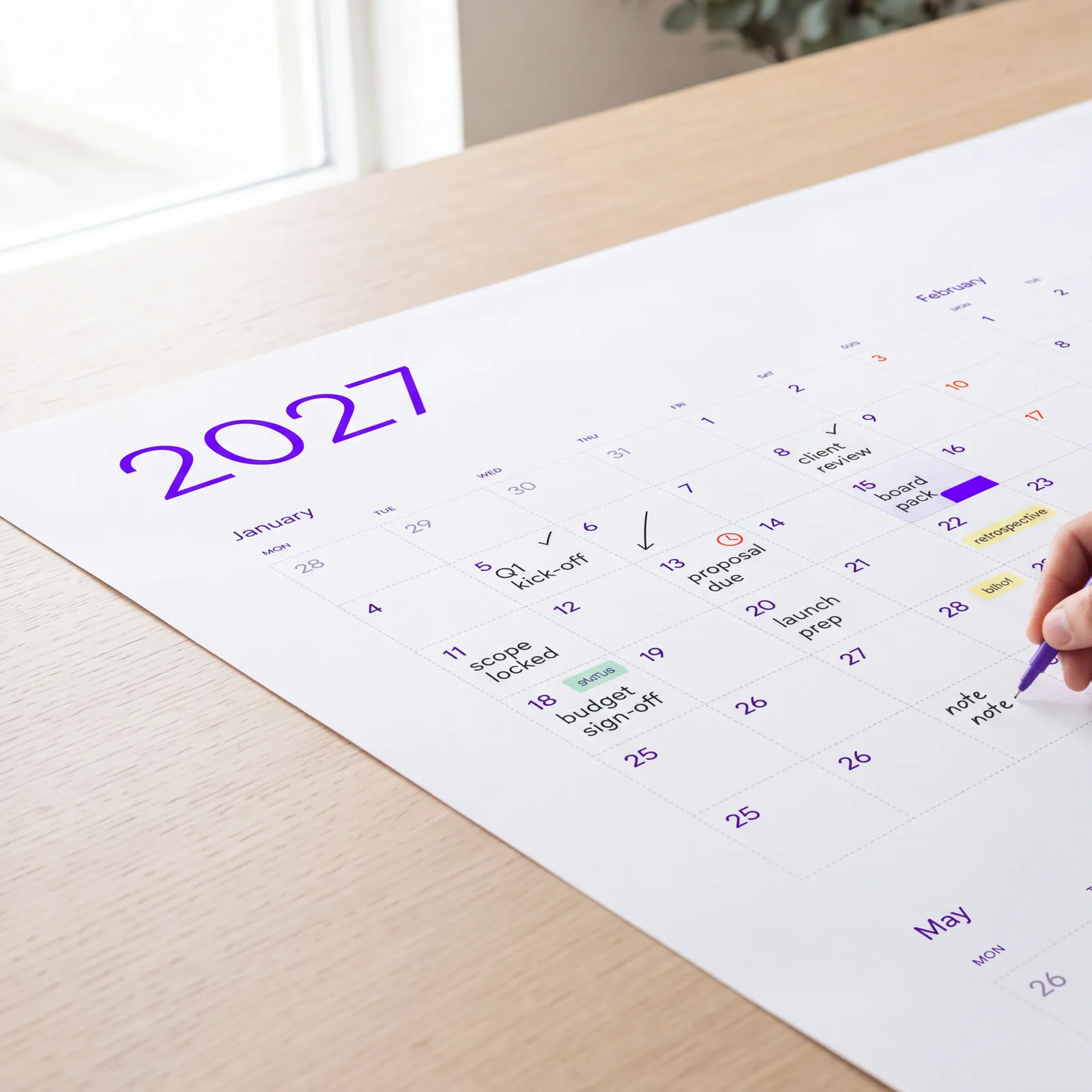
The cells have to be big enough to write in. This is the one that decides everything else. A calendar people cannot write on is a poster, and posters come down. Most promotional calendars are designed as decoration with dates printed on them, which is exactly why they are replaced in February by something functional.
The branding has to be quiet. One logo, placed once, sized so it reads across the room and no larger. The temptation is to repeat it on every month, and it is worth resisting, because a sheet that looks like an advertisement gets treated like one. A calendar the recipient is slightly proud to hang carries your name further than one plastered with it.
It has to be readable from a distance. Wall calendars are consulted while standing three metres away, not while sitting at a desk. That changes what the type has to do, and it is the reason a design that looked fine on a laptop can fail completely once it is printed at A1.
The colours have to survive the grid. Brand palettes are usually built for screens and for large areas. A year planner is thousands of small elements, so a colour that reads as confident on a website can turn a calendar into noise. Adapting a palette to a dense grid is real design work, not a filter.
The Traditional Route and What It Costs
The classic way to do this is to commission a printed calendar. A designer produces the artwork, a printer runs it, and boxes arrive at your office. It works, and it has three costs that rarely make it into the initial estimate.
The first is the minimum. Print runs get cheap per piece only at volume, so you commit to hundreds of copies before you know how many you need. The second is the lead time. Design, proofing and printing routinely take four to six weeks, which is why corporate calendar decisions have to be made in autumn and why so many of them are made in a hurry. The third is the leftovers, because whatever is not handed out by January is waste you paid for.
There is a fourth cost that is easy to overlook if your company is spread across several countries: shipping printed posters to remote offices is expensive, slow, and produces damaged tubes.
Your calendar,
your brand
Your logo, your colors, your language on the plainplan grid. $149, first draft in 48 hours.
The File Route
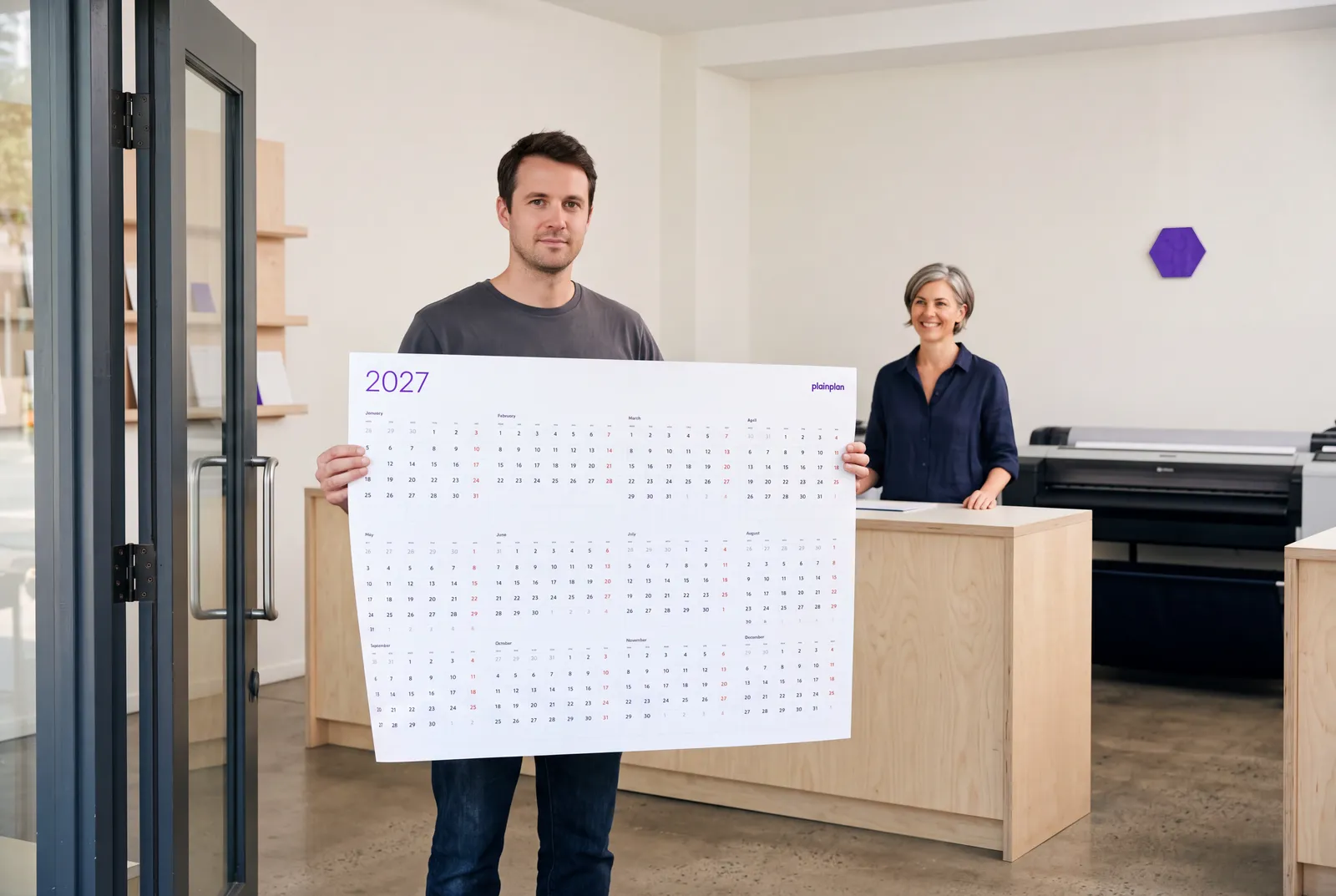
The alternative is to own the artwork rather than the boxes. You commission the design once, receive it as a vector PDF, and print exactly as many as you need, at whatever size each wall needs, whenever you need them.
That removes the minimum, the leftovers and most of the lead time in one move. It also solves the international problem: instead of shipping tubes from head office, each location prints locally at their own copy shop, in the size their wall takes, in their own language if the design has one.
The trade-off is honest to state. Somebody has to walk the file to a print shop, and for a hundred client gifts you still want a proper print run. The file route does not make printing disappear, it just stops you from committing to it before you know the numbers. And for the internal use case, where you want six copies on six office walls, it is simply the cheaper way.
How We Do It at plainplan
plainplan is a wall planner I designed because I could not buy one that worked. The grid is the product: the day cells are sized for real handwriting, the year fits on one surface, and there is nothing on the sheet that does not earn its place.
For companies we take that same grid and change two things. The colour system becomes yours, tuned by hand so the palette works across a dense grid instead of fighting it. Your logo goes on it, once, and ours comes off. The layout itself does not move, because the layout is the part that was tested.
You get both layouts, every print format from A3 to A0 and Letter to 32x48 inches, and the licence to print as many copies as you want, including for client gifts. First draft within 48 hours, one revision round, $149. Details and the order form are on the plainplan for business page.
If you want to see the design before you talk to anybody, the 2026 planner is free. Print it, put it on a wall, and see whether it is the kind of thing you would put your name on.
Frequently asked questions
For a printed run, decide in September or October, because printers get busy in November and a four to six week lead time puts you uncomfortably close to the holidays. If you are working from a file you have more room, but the print shop queue in December is still real. Earlier is cheaper in both routes.
With a printed run you have to answer that before you order, which is the whole problem. With a file you do not: print six for the offices now and another eighty in November if the client gift idea gets approved. That flexibility is usually worth more than the per-piece saving of a big run.
Lightly. One logo, placed once. A calendar covered in branding reads as an advertisement and gets taken down, which costs you the entire year of visibility you were paying for. Restraint is not modesty here, it is the mechanism.
Yes, if you send the file rather than the object. Everyone prints their own at their local shop, at the size their room takes. Shipping posters to home addresses is expensive and they arrive creased.
Less than people expect: a logo in a vector format, your brand colour, the language you want and a rough idea of the size the wall takes. Everything else can be decided during the one revision round.
