
Why I Dropped A4 From the Recommended Sizes
A4 is the size everyone already owns paper for. I still took it off the ladder, because a year on A4 leaves day cells you cannot write in.
Taking a Size Away Is the Harder Call
Adding an option is easy. Nobody complains, the list gets longer, and it looks like generosity. Removing one is the opposite. You can picture the person you are turning down - somebody with a printer on the desk, a ream of A4 next to it, no copy shop nearby, and a perfectly reasonable question: why can I not just print your planner on the paper I already have?
I sat with that for a while, because as a designer I am supposed to reduce friction, not add it. But the honest version of the job is not “make it printable everywhere”. It is “make sure the thing that arrives on the wall actually works”. Those two goals point in opposite directions at exactly one size, and I picked the second one.
So A4 came off the recommended ladder and off the size comparison shown on the site. Not because it broke anything technically, but because recommending it meant recommending a version of the planner I would not use myself.
It Was Never About What the File Can Do
The planner is a vector PDF. There is no resolution in it to run out of - the lines are described as geometry, so the file scales to any size a printer will accept and stays sharp. A4 was never technically impossible, and it still is not. If you open the file and print it on A4 today, you will get a clean, correctly proportioned, perfectly crisp page.
That is the uncomfortable part of this decision. I could not hide behind a technical excuse. Nothing fails. The file behaves. What changes is what you can do with the result once it is on the wall.
If you want the mechanics of scaling a single file across paper sizes, I wrote that up separately in how to print a wall calendar at any size.
The Whole Decision Is One Day Cell
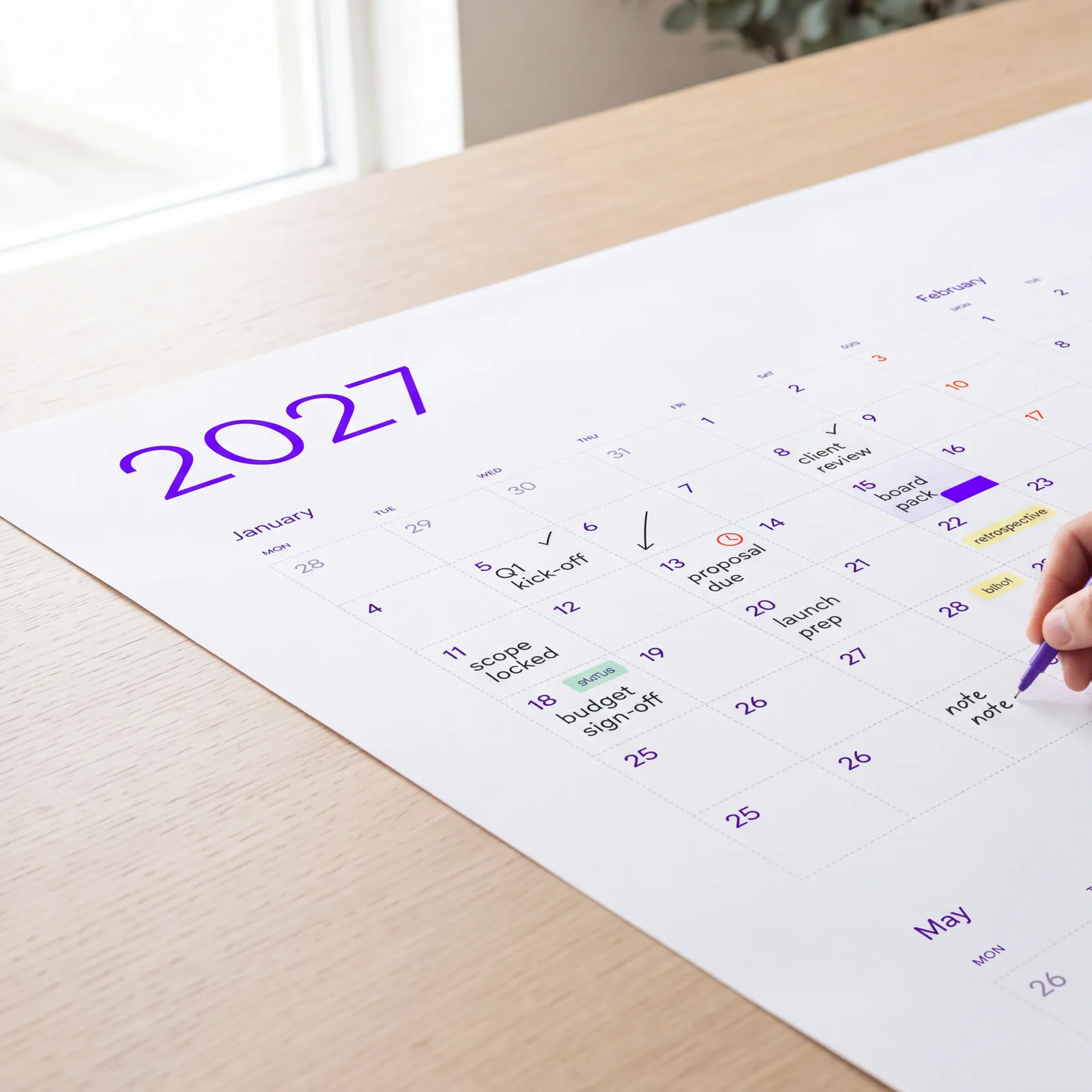
A wall planner is a whole year on one sheet. That constraint is the product - it is why you can see July from January. But it also means the sheet gets divided into 365 cells, and the size of the paper decides the size of the cell. There is no design trick that gets around that arithmetic.
On A4, that division leaves a cell you cannot write a real note in. Not “a bit tight” - genuinely too small for a handwritten word at normal pen size. And writing in the cell is the one thing this planner exists for. Take that away and you are left with a nice picture of a year: something you look at, admire briefly, and never touch again.
That was the line for me. A planner you do not write on has quietly stopped being a planner. Every argument for keeping A4 was an argument about convenience before the purchase; the argument against it was about the next twelve months of using the thing. The second one wins.
The Counter-Argument I Get Most
“Most people own an A4 printer and no A3 one. There is no copy shop in my town. You are pushing me to an errand I did not ask for.” That is fair, and I am not going to pretend it is not a real cost.
Here is my answer. The errand is a one-off, and it is smaller than it sounds. Online print services ship a large-format poster to your door for the price of a couple of coffees, and copy shops handle A3 to A0 as ordinary daily work - the file is designed to be handed over without any explanation. Meanwhile the alternative is not “no errand”, it is a year of squinting at boxes you cannot write in.
There is also a version of the compromise that works: A3. It is one step up, plenty of print shops do it cheaply, and some home printers manage it. A3 is the first size where the cells are usable, which is exactly why the ladder now starts there instead of one step lower. And if you would rather not think about paper stock at all, the paper guide gives you a single order to copy and paste.
Try 2026 for free
before you buy 2027
One file. Any wall. Always sharp.
The Ladder That Replaced It
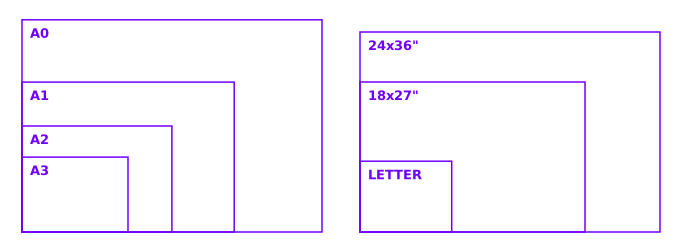
The recommendation now runs A3 at home, A2 for most rooms, A1 for offices and family walls, and A0 when you want the year to be the thing people notice when they walk in. Four rungs, each one an honest answer to a different wall.
The US equivalents follow the same logic on the 2:3 ratio: Letter at home, 24x36 inches for a room, 32x48 inches as the statement size. Same ladder, different paper tradition.
Every rung on that list is a size where the planner still does its job. That is the only test a size has to pass to be on it.
What A4 Is Still Good For
I did not delete A4 from the universe, and the file will still happily print on it. It has one honest use left, and it is a genuinely useful one: the test print.
Before you pay for a large format print, run the file on A4 at home. You get to check that the layout is what you expected, that the colours look the way you want them to on paper rather than on a backlit screen, and that you picked the layout - vertical grid or square grid - you actually meant to pick. Ten minutes and one sheet of paper, and you find out before the copy shop invoice rather than after it.
That is A4's role here: a proof, not a product. Useful for the decision, not for the year.
The Same Reason Killed the Arch Series
A4 was not the first format I cut. The Arch paper series went earlier, for a related reason: it added a whole format family without adding a use. Everything an Arch size could do was already covered by a size that was easier to order, and the only thing it reliably produced was another decision for the customer to make at checkout.
Both cuts come from the same rule I now apply to the size list. A format earns its place by being the best answer for a specific wall. If it is only there so the table looks fuller, it is costing the buyer attention and giving nothing back.
That is what I mean when I say the hard version of the job is subtraction. The list is shorter than it was a year ago. It is also, finally, a list I would hand to a friend without a footnote attached.
Frequently asked questions
Yes. It is a vector PDF, so it prints at any size your printer accepts and stays sharp. A4 was removed from the recommended sizes and from the size ladder on the site, not from the file. I just do not recommend it as your actual wall planner, because the day cells end up too small to write in.
A3 in Europe, Letter in the US. A3 is the first step where a day cell is big enough for a handwritten note, and it is a size most copy shops print cheaply and some home printers handle directly.
Because the constraint is arithmetic, not design. A whole year on one sheet means the sheet gets divided into 365 cells. Shrink the sheet and every cell shrinks with it. The only way to make A4 cells writable would be to drop days off the page, which would stop it being a year-at-a-glance planner.
A2, or 24x36 inches in the US. It reads comfortably from across a room, the cells take a full short note, and it is a standard poster size everywhere, so printing and framing are both easy. A1 and A0 are for offices, family walls, and rooms where you want the year to dominate.
