
Long-Term Goal Setting With a Wall Planner: A System That Survives Past January
Most goal-setting frameworks fail not because the goals are wrong but because the system disappears. A wall planner fixes a specific part of that problem: visibility.
Start With One or Two BHAGs
BHAG — Big Hairy Audacious Goal — is a term coined by Jim Collins and Jerry Porras in their 1994 book Built to Last. The concept translates cleanly to personal planning. Rather than starting with a list of fifteen resolutions, start with one or two outcomes that would genuinely change something if you achieved them by December.
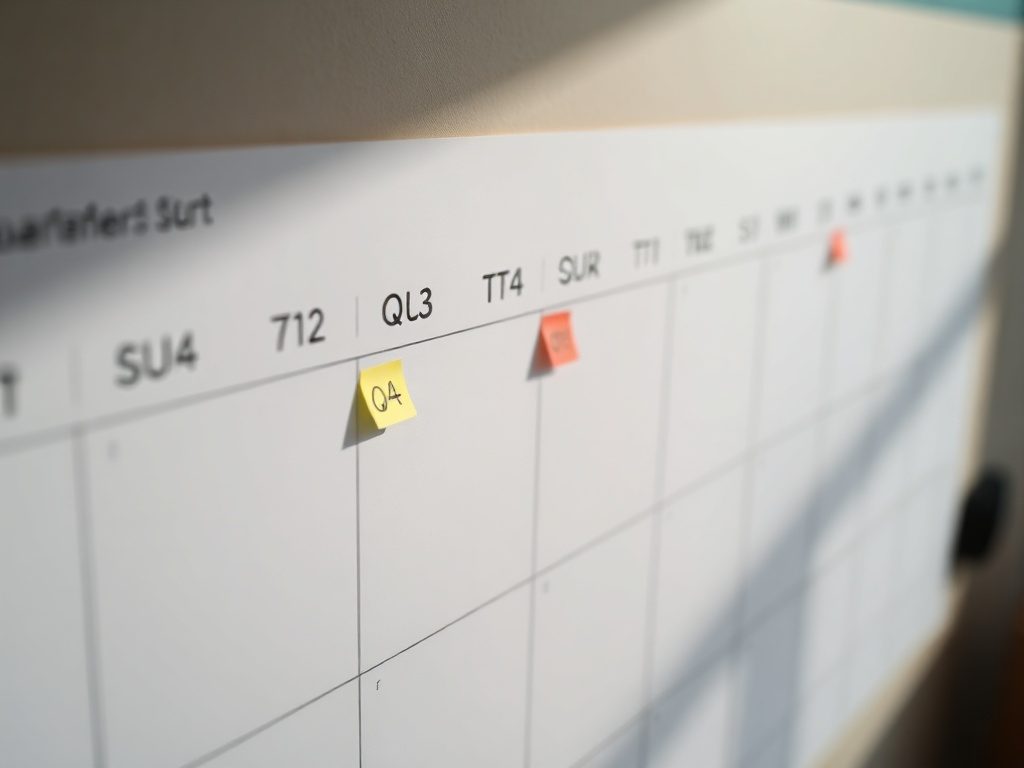
Write these on a sticky note and put it above the planner, not on it. The planner is for time, not for ambition. The BHAG is the destination. The planner is the map.
One BHAG is enough. Two is workable. Three or more and you’re probably listing aspirations rather than commitments. The discipline here is in the reduction, not the volume.
Break the Year Into Four Chunks, Not Twelve
Monthly planning sounds granular and therefore useful. In practice, a month is too short to see meaningful progress on big goals and too long to feel urgent. Quarters are better — long enough for real movement, short enough to stay accountable.
Mark the last day of each quarter on the planner before you write anything else: March 31, June 30, September 30, December 31. These are your review dates. Then ask: what would need to be true by the end of Q1 for the year to be on track? Write that milestone in the last week of March.
This is the logic behind OKRs — the goal-setting method described by John Doerr in Measure What Matters. Key Results are time-bound milestones, typically set quarterly, that make the objective concrete. The same principle applies on a wall planner: work backward from each quarter-end to the first week, and mark what needs to happen in each month to make the Q1 milestone possible.
What to Write — and What to Leave Off
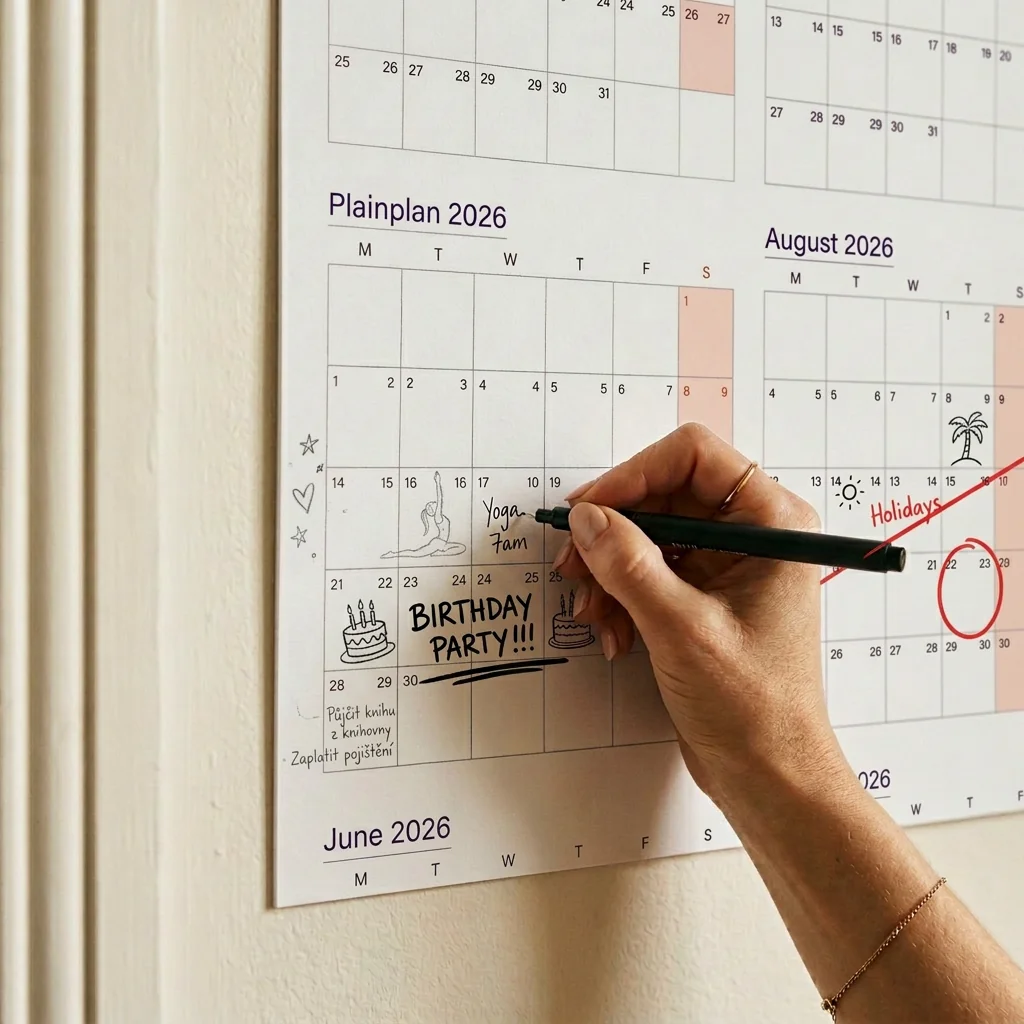
The planner is not a task list. Daily tasks, meeting notes, and shopping lists don’t belong on it. Those live in a notebook or an app. The wall planner is for things that are true about a specific point in time: a milestone reached, a decision that must be made, a lead time that starts.
What belongs on the planner: milestone dates (quarterly and monthly), major decision deadlines, blocks of time when something needs to be in motion (“Q2: partnership negotiations”), and hard external dates like launches, events, or fiscal periods.
What stays off: anything that repeats weekly, anything that’s someone else’s responsibility to remember, and anything you’d be embarrassed to have visible in a shared space. The planner should show the shape of the year, not the texture of every day.
Fill the Whole Year Before January Starts
The most common planning failure is front-loading January. You map out January in detail, sketch vague intentions for Q1, and leave the rest of the year completely blank. Then January passes, Q1 ends without a review, and the year is effectively unplanned from April onward.
The fix is mechanical: before January 1, block out the whole year with milestones. Even rough ones. “Something significant by end of Q3.” “Major push in October.” The specifics will change, but having marks on the later months creates a psychological anchor. An empty September has no gravity. A September with a milestone on it does.
Set up the planner in December of the previous year. Place quarterly markers first, then work backward from each one. Leave the grid mostly empty — you’ll fill it as the year develops — but don’t leave any quarter entirely blank. If you’re using a structured annual review to close out the year, the setup session fits naturally at the end of it.
Two Reviews: Weekly and Quarterly
A five-minute weekly check-in keeps the planner accurate. Every week, stand in front of it. Look at the current month and the next. Are you where you expected to be? Is there anything that needs to move? This isn’t a planning session — it’s a calibration. Most weeks, nothing changes.
The quarterly review is 30 minutes. At the end of each quarter, assess the milestone: did you hit it? If not, why not, and does the rest of the year need to adjust? Update the remaining quarters based on what you learned. This is where the system actually adapts.
Two reviews is enough. Daily journaling, weekly planning sessions, and monthly retrospectives sound thorough but they become the activity instead of the support structure. The goal is for the planner to serve your work, not to become its own project. For a deeper approach to the year-end review, see how to use a wall planner for your annual review.
Ambient Accountability Without Maintenance
The reason this system survives past January is that it requires almost no maintenance. You don’t need to open an app, remember a password, or sit down with a notebook. The year is on the wall. When you walk past it every day, you absorb where you are and where you’re supposed to be.
That ambient awareness is the mechanism. It’s not motivation — a wall planner can’t motivate you. It’s orientation. You always know roughly where in the year you are and what’s coming. That steady orientation makes it harder to drift into September wondering where the year went.
The physical act of writing on a wall planner also matters in a small but real way. Writing a milestone on a calendar feels more like a commitment than typing it into a field. It’s harder to delete, more visible when you ignore it, and slightly more embarrassing to leave blank when you said you’d have something done. If you’re new to this approach, this guide on how to use a wall planner covers the basics.

Frequently asked questions
One or two big goals for the year, expressed as quarterly milestones. The planner is not a wish list — it’s a map. More than three major goals and you’re likely to underdeliver on all of them. Reduce first, then plan.
A resolution is typically an intention (“exercise more”). A BHAG is a specific, ambitious outcome with a real deadline (“complete a half-marathon by October”). The specificity is what makes it plannable — you can work backward from a concrete goal; you can’t work backward from a vague aspiration.
Weekly for minor calibrations, quarterly for structural updates. The daily texture of your work belongs in a notebook or task app — the planner captures only milestones and major dates. If you’re updating it more than once a week, you’re using it as a task list rather than a planning tool.
Yes — it’s particularly useful for freelance and creative work where external deadlines are sparse. The quarterly milestone structure creates internal accountability that replaces the deadlines a manager or client would otherwise set. The ambient visibility of the planner keeps project timelines present even when no one else is checking in.
Sources
Your year. Your wall.
One file. Any wall. Always sharp.